Protect Your Mental Health During a Long Job Search
A practical guide for protecting energy during a long search by limiting low-quality applications, tracking signals, and keeping follow-up habits sustainable.
Built for Indian freshers, lateral hires, return-to-work candidates, and remote job seekers.
What to decide before acting
- Use this guide to run a focused job search instead of applying randomly.
- Prioritize evidence: role filters, application notes, resume versions, follow-up dates, recruiter responses, and shortlist patterns.
- Replace broad claims with role-specific proof, plain language, and one next action.
- Use ConnectsBlue as a support workflow, then edit final output so it sounds like a real candidate.
Starting point
Before the next step in job search mental health
The first move is to define the reader's real situation: target role, career stage, urgency, constraints, and the evidence already available.
Indian candidates often apply across Naukri, LinkedIn, company career pages, walk-ins, referrals, and campus or off-campus drives, so tracking quality matters.
For Protect Your Mental Health During a Long Job Search, a candidate should avoid copying a polished example before deciding what problem the example is meant to solve.
- Name the role or role family before making changes.
- List the strongest proof that already exists.
- List the missing proof that needs a project, course, referral, or practice session.
- Decide what should change this week, not someday.
Selection signals
What recruiters need to see in job search execution
Recruiters are not reading for personality alone. They are checking whether the candidate has enough evidence to justify the next step.
For this topic, the evidence usually includes role filters, application notes, resume versions, follow-up dates, recruiter responses, and shortlist patterns. If those details are absent, better formatting will not solve the core problem.
| Recruiter question | Candidate evidence | Weak version to avoid |
|---|---|---|
| Can this person do the role? | Specific proof with skill use, project scope, and domain context | A list of tools without outcomes |
| Will they be easy to evaluate? | Clear examples and concise summaries | Long paragraphs with no decision signal |
| Can they join or proceed? | Notice period, city, work mode, salary expectation, and constraints | Late-stage surprises |
| Are they improving? | A feedback log, revised asset, or practice answer | Repeating the same approach after rejection |
Candidate workflow
A simple weekly workflow for job search execution
Set aside one weekly review block. Update the target roles, revise one asset, practice one answer or outreach message, and record what happened.
ConnectsBlue works best as part of that loop: browse, build, check, practice, or track, then return to the candidate's own facts.
- Monday: choose the role or application batch.
- Tuesday: update proof and wording.
- Wednesday: practice or check the asset.
- Friday: review response quality and revise one thing.
Quality filter
How to make the advice fit your situation
Advice becomes useful when it names trade-offs. The reader should understand what to do when the recommendation does not perfectly fit their background.
Remove language that sounds impressive but cannot be checked. Replace it with a role, a fact, a constraint, or a next step.
- Remove broad adjectives unless they are supported by evidence.
- Avoid fake urgency and broad promises.
- Use product workflows as examples, not as unverified outcomes.
- Make one recommendation the reader can act on today.
Product proof
ConnectsBlue jobs shown as a real search surface
The article links search advice to real job discovery pages where candidates can browse active roles and compare fit before applying.
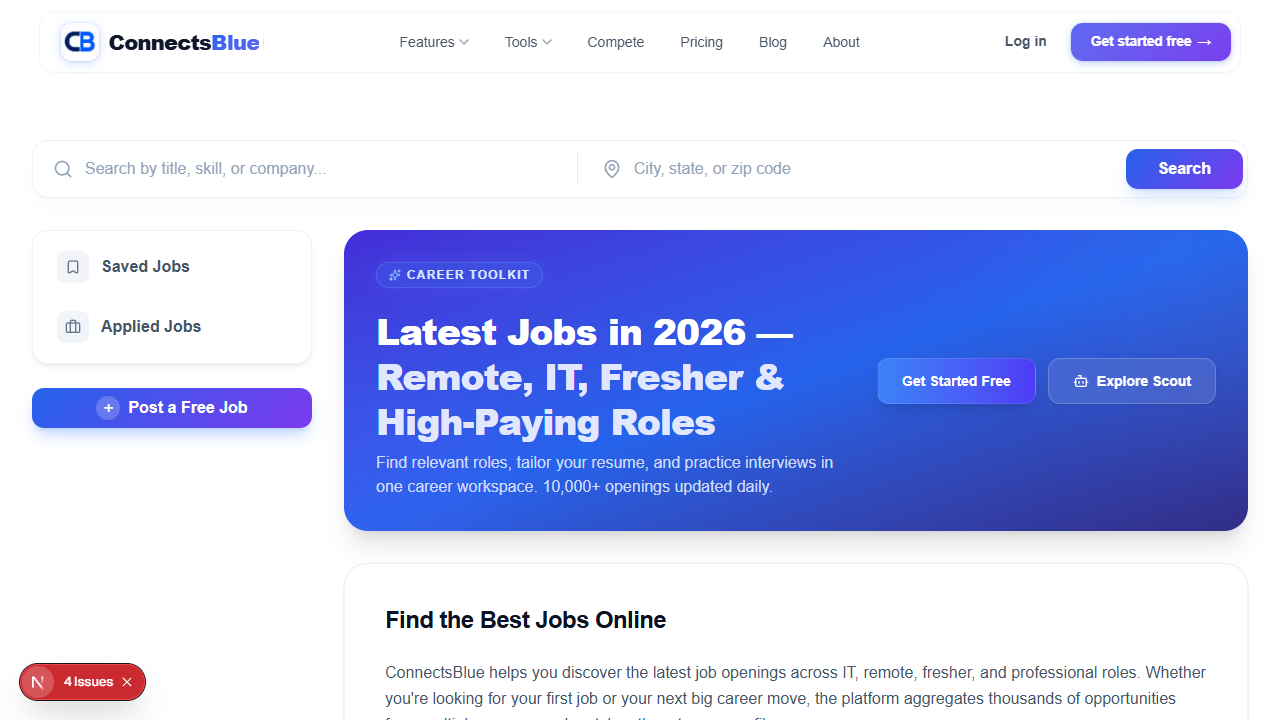
Screenshot captured from the public ConnectsBlue product experience.
Readiness checklist
Before the next step in job search mental health
Use this list to keep the next step specific to your role, constraints, and evidence.
- Read the target job description and mark the top five selection signals.
- Prepare proof for each signal from work, internship, project, certification, or portfolio evidence.
- Check whether the resume, cover letter, interview answer, or outreach message uses the same facts.
- Remove vague phrases that any candidate could say.
- Use the relevant ConnectsBlue workflow only after the source material is ready.
- Save the final version and review outcomes after one week.
Application notes
What to confirm before applying
What is the most important part of job search execution?
The most important part is evidence. For this topic, candidates should prepare role filters, application notes, resume versions, follow-up dates, recruiter responses, and shortlist patterns so recruiters can understand fit quickly.
How does this apply to Indian candidates?
Indian candidates often apply across Naukri, LinkedIn, company career pages, walk-ins, referrals, and campus or off-campus drives, so tracking quality matters. Candidates should also prepare notice period, expected CTC, location preference, and joining timeline answers early.
Should candidates rely completely on ConnectsBlue tools?
No. Use the tools to structure, review, and improve the work. The final version should still be checked by the candidate and written in a truthful personal voice.
How is this different from broad career advice?
It uses concrete hiring signals, India-specific constraints, visible product proof, FAQs, checklists, and practical examples instead of repeated hype phrases.
Make it concrete
Replace broad advice with one specific action.
Use the job search mental health angle to choose one action you can complete this week, then check whether it improves recruiter or interview response.
Related Guides
Continue with practical articles on the same theme
Strategic Networking: Building a Resilient Professional Architecture
This interview guide focuses on what to practice before the call, what to listen for during it, and how to improve after feedback or rejection.
Job Search Metrics: Use Data Without Over-Optimizing
This interview guide focuses on what to practice before the call, what to listen for during it, and how to improve after feedback or rejection.
Remote Work Salaries: How Global Pay Bands Are Changing
This salary guide keeps negotiation practical: know the range, document impact, understand tradeoffs, and decide what matters before the call.