Indian Tech Salary Guide: Compare Pay by City and Role
A regional salary guide for Indian tech candidates comparing city bands, role level, skill premiums, benefits, and offer trade-offs.
Indian tech compensation varies sharply by city, role family, services versus product context, GCC maturity, startup stage, and skill scarcity.
What to take from this guide
- Compare fixed pay before celebrating CTC growth.
- Read variable pay, retention bonus, equity vesting, and benefits carefully.
- Adjust salary expectations by role level, city, company type, and skill premium.
- Use offer notes to decide whether higher pay also increases risk or constraints.
CTC breakup
Separate fixed pay from the parts that may not arrive monthly
In India, CTC can include fixed pay, variable pay, provident fund, gratuity, insurance, joining bonus, retention bonus, stock, food benefits, and other components.
The monthly reality depends on which parts are fixed, which are performance-based, and which vest over time.
- Ask for fixed pay and in-hand estimate separately.
- Check whether variable pay is individual, team, or company-linked.
- Read joining and retention bonus clawback terms.
- Compare equity only after understanding vesting and liquidity.
Market comparison
Compare by city, company type, level, and skill premium
Salary ranges shift by city and company type. A candidate should compare offers against similar roles, not against every number shared online.
Skill premiums also change quickly. Cloud, data engineering, cybersecurity, platform engineering, product analytics, and strong QA automation can change the range when the proof is real.
| Comparison factor | Why it matters | Question to ask |
|---|---|---|
| City | Cost and pay bands differ across hubs | Is this band location-based or national? |
| Company type | Services, GCCs, startups, and product firms price roles differently | What role scope does this level own? |
| Skill premium | Scarce skills can move bands if proof is credible | Which skills are valued in this team? |
| Work model | Remote, hybrid, and relocation affect real value | What are office and travel expectations? |
Offer risk
Higher CTC can still be weaker than it looks
A larger CTC may hide high variable pay, uncertain equity, weak benefits, relocation cost, long commute, or fragile role scope.
Use ConnectsBlue to keep comparable roles and notes visible so each offer is judged against the candidate real constraints.
- Compare monthly fixed pay before total CTC.
- Check probation, appraisal cycle, and bonus payout history.
- Compare notice-period and joining-date expectations.
- Ask how the role level maps to future growth.
Product proof
Career GPS shown inside ConnectsBlue
The guide connects planning advice to the real roadmap surface candidates use to define target roles, skill gaps, milestones, and next actions.
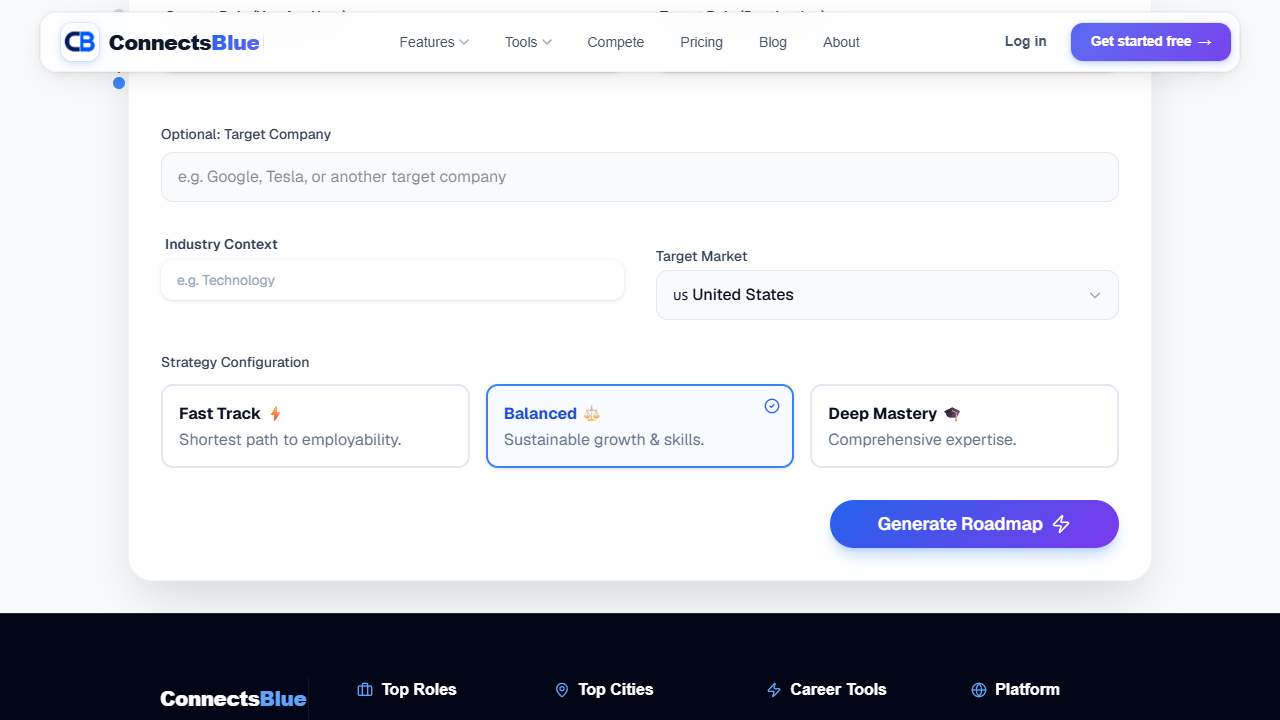
Screenshot captured from the public ConnectsBlue product experience.
Before accepting
Before accepting an Indian tech offer
Use this checklist to compare fixed pay, variable pay, city, role level, benefits, equity, and joining constraints.
- Ask for fixed pay, variable pay, and in-hand estimate separately.
- Compare the offer with similar city, role, level, and company type.
- Read joining bonus, retention bonus, and clawback terms.
- Check appraisal cycle, probation, and benefits.
- Evaluate commute, relocation, remote policy, and notice-period impact.
- Keep a written comparison before accepting.
India salary FAQ
Questions candidates ask about Indian tech salaries
Is CTC the same as take-home salary?
No. CTC can include components that are not paid monthly or are conditional. Always separate fixed pay and estimated in-hand salary.
Which city pays best for tech jobs in India?
It depends on role family, company type, and level. Bangalore, Hyderabad, Pune, Chennai, NCR, Mumbai, and remote roles each have different trade-offs.
Should I value equity in a startup offer?
Value equity only after understanding vesting, strike price where relevant, dilution, liquidity, and company stage. Treat uncertain equity separately from fixed cash.
How should freshers compare salary offers?
Freshers should compare fixed pay, learning quality, role clarity, location cost, bond or service terms, and whether the work builds credible experience.
Next step
Compare the real offer, not only the CTC
Break down the compensation, then compare it against role scope, city, risk, and growth.
Related Guides
Continue with practical articles on the same theme
Salary Negotiation Guide: Ask With Market Evidence
A practical negotiation guide for researching market range, timing the ask, comparing base pay with benefits, and choosing a calm counter-offer.
Global Salary Trends: Compare Offers Across Markets
A compensation-trend guide for candidates comparing remote pay, local bands, currency risk, equity, and benefits across markets.
Remote Pay: How to Benchmark International Offers
Remote Pay: How to Benchmark International Offers helps candidates compare pay with context instead of reacting only to the base number or the loudest salary headline.