Career Change at 30: Plan the Move With Evidence
An age-specific career-change guide for candidates who need to protect income, explain transferable proof, and test a new role before making a risky move.
A career change at 30 usually has a salary floor, notice-period constraint, family or debt obligations, and less room for vague exploration.
What to prepare first
- Do not start by rewriting every profile. Start by naming the income floor, target role, and transferable proof.
- Use two proof assets: one from prior work and one small target-role project that shows current readiness.
- Test the move through interviews, referrals, and job descriptions before treating the career change as a full restart.
- Keep a fallback path for salary, location, notice period, and learning time so the move does not depend on optimism.
Starting point
At 30, the question is not whether you can start over
Most candidates changing careers around 30 are not starting from zero. They are carrying work history, salary expectations, responsibilities, and habits that can either become proof or become friction.
The first step is to name the constraint set clearly: minimum monthly income, notice period, location or remote preference, learning time, and the target role family. Without that list, every option looks equally possible and equally vague.
A good career-change plan turns prior work into evidence a recruiter can understand. It does not pretend that enthusiasm replaces proof.
- Write the salary floor before comparing roles.
- Choose one target role family, not five unrelated options.
- List three transferable examples from past work.
- Name the skill gap that would block a recruiter from shortlisting you.
Proof map
Translate previous work into the language of the target role
A teacher moving into customer success, a QA engineer moving into product, or a support lead moving into operations should not erase their past work. The work needs translation.
The strongest profile connects responsibilities, decisions, constraints, and outcomes from the old role to selection signals in the new one.
| Old-role evidence | Target-role translation | Weak version to avoid |
|---|---|---|
| Handled escalations | Stakeholder management, prioritization, and communication under pressure | Good communication skills |
| Improved manual workflow | Process mapping, operations thinking, and measurable workflow improvement | Hardworking and adaptable |
| Trained juniors or students | Enablement, documentation, coaching, and quality control | Team player |
| Tracked issues or outcomes | Analytical habit, reporting discipline, and follow-up ownership | Data-driven mindset |
Market check
Test the change before making it irreversible
A mid-career move should be tested in the market before it becomes a resignation letter. Shortlist roles, speak with people doing the work, and build one small proof asset that maps to the job description.
ConnectsBlue can support the planning loop by helping candidates compare roles, organize applications, and keep the transition plan tied to real hiring signals instead of a mood board.
- Run five job descriptions through the same selection-signal checklist.
- Build one small project or case note that proves the missing skill.
- Ask two people in the target role what would make the switch credible.
- Track recruiter response before increasing application volume.
Application plan
Make the resume, LinkedIn profile, and interview story agree
The resume should show transferable proof. The LinkedIn profile should make the target role obvious. The interview story should explain why the move is deliberate, not random.
If those three assets tell different stories, recruiters will treat the candidate as unfocused even when the underlying experience is strong.
- Use the same target title language in headline, resume summary, and outreach.
- Keep prior-role proof but rewrite it around the new role signals.
- Prepare a short answer for why the change makes sense now.
- Review salary and location constraints before late-stage interviews.
Product proof
Career GPS shown inside ConnectsBlue
The guide connects planning advice to the real roadmap surface candidates use to define target roles, skill gaps, milestones, and next actions.
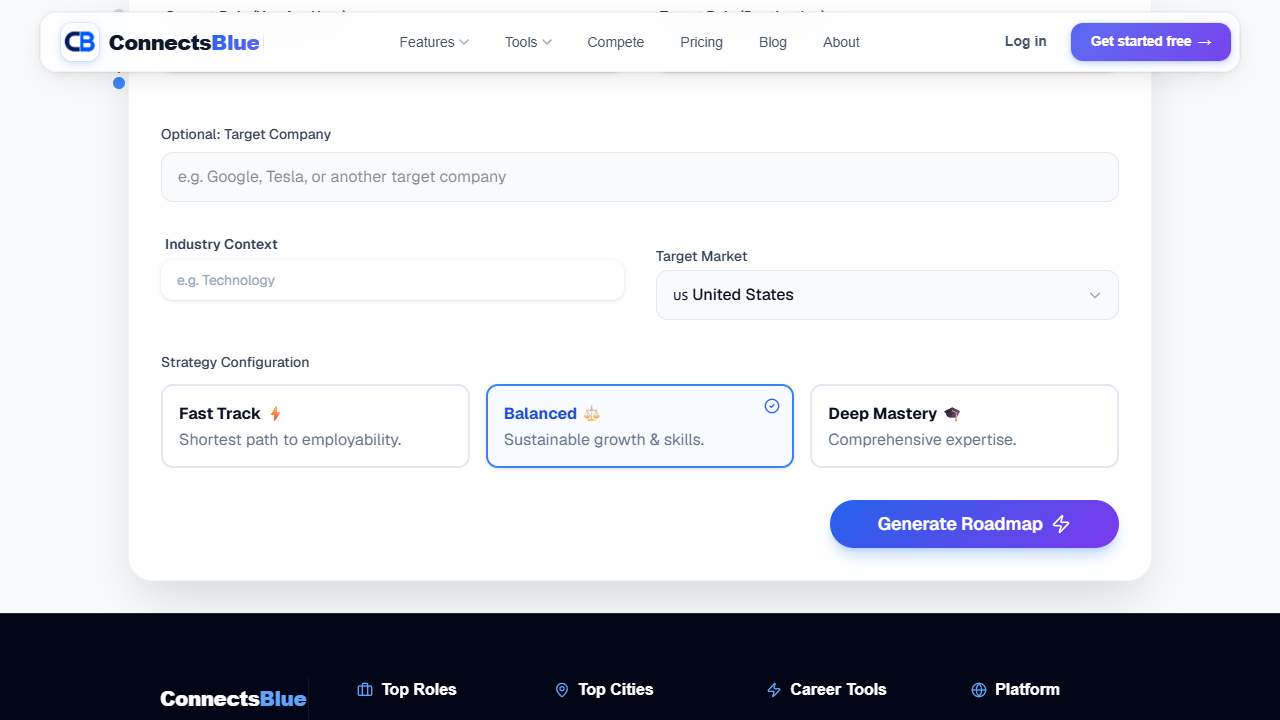
Screenshot captured from the public ConnectsBlue product experience.
Before switching
Before committing to the career change
Use this checklist to make sure the move is supported by salary reality, transferable proof, and evidence from the target market.
- Write the minimum compensation, location, and notice-period constraints.
- Choose one target role family and collect five representative job descriptions.
- Translate prior work into target-role selection signals.
- Create one proof asset for the biggest current skill gap.
- Test the story through networking, interviews, or recruiter feedback.
- Update resume, LinkedIn, and interview answers so they tell the same transition story.
Career-change doubts
Questions candidates ask before changing careers at 30
Is 30 too late to change careers?
No. The risk is not age by itself; the risk is making an unfocused move without proof, salary planning, or a clear target role. Prior experience can become useful evidence when it is translated properly.
Should I take a large salary drop to switch fields?
Only after comparing the long-term path, runway, and offer structure. Set a salary floor first, then look for adjacent roles where prior experience still has value.
How do I explain the change in interviews?
Use a short story: what you learned in the current field, what selection signal attracted you to the new role, what proof you have built, and why the move is practical now.
What should I build before applying?
Build one proof asset that addresses the biggest doubt a recruiter would have: a project, case note, portfolio sample, process improvement, analysis, or documented learning outcome.
Use the workflow
Build the proof before you make the leap
Use a target role, salary floor, proof map, and market feedback to decide whether the move is ready.
Related Guides
Continue with practical articles on the same theme
Career Transition Guide: Change Industries With Proof
A practical career-transition guide for mapping transferable proof, naming real skill gaps, and testing a target role before rewriting every resume or profile.
Protect Your Mental Health During a Long Job Search
A practical guide for protecting energy during a long search by limiting low-quality applications, tracking signals, and keeping follow-up habits sustainable.
Remote Work Salaries: How Global Pay Bands Are Changing
This salary guide keeps negotiation practical: know the range, document impact, understand tradeoffs, and decide what matters before the call.