Career GPS Guide: Build a Practical Job Roadmap
A public Career GPS guide for turning a private roadmap into target roles, skill gaps, proof projects, milestones, and weekly review habits.
A roadmap is useful only when it turns ambition into target roles, skill gaps, proof projects, and review dates.
What to take from this guide
- Start with constraints before choosing target roles.
- Turn each skill gap into a proof project or interview example.
- Review the roadmap against real job descriptions, not only personal preference.
- Use the private workspace for planning, but keep the public guide useful without login.
Constraints first
A useful roadmap starts with what cannot be ignored
Before choosing a target role, write down the constraints that will shape the move: salary floor, work location, notice period, learning time, family responsibilities, and timeline.
These constraints do not make the roadmap smaller. They make it honest enough to act on.
- Set a salary floor before comparing roles.
- Name the preferred work model and commute limit.
- Decide how many hours per week can go into learning.
- Write the timeline for applications, interviews, and transition.
Role map
Convert goals into target roles and selection signals
A goal such as better growth or a more stable company is too broad for a roadmap. Convert it into target roles, job descriptions, and selection signals.
The strongest plan compares what employers ask for with the proof the candidate can already show.
| Roadmap item | What to write | Why it matters |
|---|---|---|
| Target role | One primary role family and one backup | Prevents scattered applications |
| Skill gap | A missing requirement seen in job descriptions | Keeps learning market-linked |
| Proof project | A small artifact or example that proves readiness | Turns learning into evidence |
| Review date | A date to inspect progress and response quality | Stops plans from going stale |
Roadmap review
Check the plan against market response
A roadmap should change when the market gives useful feedback. Low replies, repeated interview gaps, or salary mismatch are signals to adjust.
Use Career GPS to keep direction visible, then use Scout, resume work, and interview practice to test whether the direction is working.
- Review whether saved roles still match the plan.
- Update proof projects after recruiter or interview feedback.
- Pause goals that conflict with non-negotiable constraints.
- Keep one next action visible for each milestone.
Product proof
Career GPS shown inside ConnectsBlue
The guide connects planning advice to the real roadmap surface candidates use to define target roles, skill gaps, milestones, and next actions.
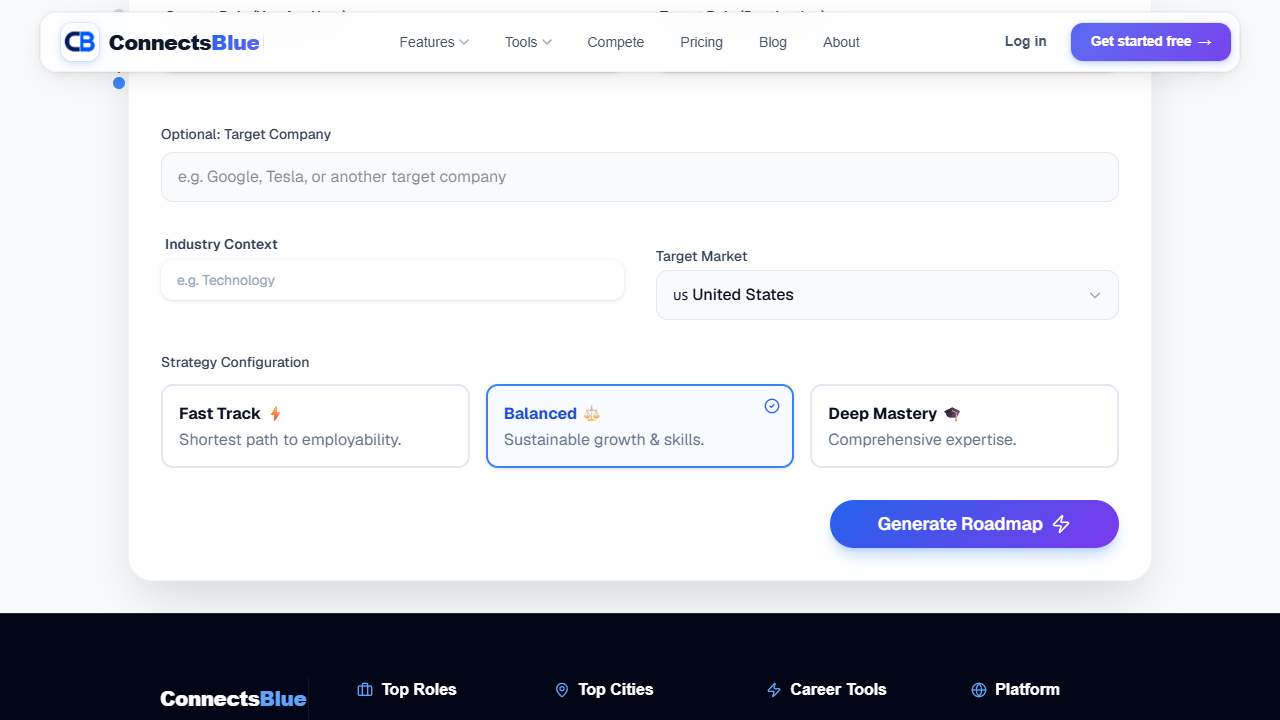
Screenshot captured from the public ConnectsBlue product experience.
Before planning
Before building a career roadmap
Use this checklist to define constraints, target roles, skill gaps, proof projects, and review dates before using Career GPS.
- Write salary, location, work-mode, and timeline constraints.
- Choose one primary target role family.
- Collect five job descriptions and mark repeated requirements.
- Turn the biggest gap into a proof project.
- Set a review date for applications and interview feedback.
- Use the private Career GPS workspace when ready to plan interactively.
Roadmap FAQ
Questions candidates ask about Career GPS
Is Career GPS public or logged-in?
The guide is public. The interactive planning workspace should be used after sign in so the roadmap can be saved and connected to the candidate workflow.
What should I do before using Career GPS?
Write your constraints, choose a target role family, and collect a few representative job descriptions. That makes the roadmap more specific.
How often should I update a career roadmap?
Review it weekly during an active search and monthly during slower planning. Update it when real market feedback changes the assumptions.
Can a roadmap help career changers?
Yes, especially when it translates prior experience into target-role proof and names the skill gaps that need evidence.
Next step
Build a roadmap that can survive real market feedback
Use constraints, job descriptions, proof projects, and review dates to keep the plan practical.
Related Guides
Continue with practical articles on the same theme
Protect Your Mental Health During a Long Job Search
A practical guide for protecting energy during a long search by limiting low-quality applications, tracking signals, and keeping follow-up habits sustainable.
Remote Work Salaries: How Global Pay Bands Are Changing
This salary guide keeps negotiation practical: know the range, document impact, understand tradeoffs, and decide what matters before the call.
Networking in the Digital Age Without Sounding Transactional
This networking guide focuses on credibility: who to contact, what to say, when to follow up, and how to keep the relationship useful.