Career Transition Guide: Change Industries With Proof
A practical career-transition guide for mapping transferable proof, naming real skill gaps, and testing a target role before rewriting every resume or profile.
A career transition is broader than a career change at a specific age. It can mean moving domains, returning after a break, shifting from services to product, or moving from execution to leadership.
What to decide before acting
- Translate previous work into the language of the target role.
- Name the exact doubt a recruiter may have about the transition.
- Build one proof asset for the biggest gap before applying at volume.
- Keep resume, LinkedIn, and interview story consistent.
Transferable map
Translate old work before chasing new titles
Prior experience does not become useful automatically. It needs to be translated into the decision language of the target role.
Start by listing responsibilities, decisions, constraints, and outcomes from the current path, then map each one to a target-role signal.
- Convert responsibilities into outcomes and decisions.
- Keep domain language only when the new audience will understand it.
- Remove achievements that distract from the target role.
- Use one resume summary that explains the transition plainly.
Recruiter doubts
Answer the doubt before the recruiter has to guess
Every transition creates a question. The candidate may lack domain depth, recent hands-on work, management scope, local experience, or proof of the target skill.
A strong transition plan names that doubt directly and builds evidence around it.
| Transition doubt | Evidence to prepare | Weak response |
|---|---|---|
| No direct title match | Comparable responsibilities and outcomes | I am a quick learner |
| Skill gap | Small project, certification, or case note | I am currently learning |
| Domain shift | Customer, process, or workflow overlap | I want a new challenge |
| Seniority shift | Decision, mentoring, or ownership examples | I handled many tasks |
Market check
Test the transition before scaling applications
Apply to a small set of representative roles first. Review replies, recruiter questions, and interview gaps before increasing volume.
Use ConnectsBlue to connect the transition plan with resume work, role comparison, and interview practice so feedback is not lost.
- Collect five representative job descriptions.
- Build one proof asset around the largest gap.
- Ask two practitioners what would make the move credible.
- Adjust the story after real recruiter feedback.
Product proof
Career GPS shown inside ConnectsBlue
The guide connects planning advice to the real roadmap surface candidates use to define target roles, skill gaps, milestones, and next actions.
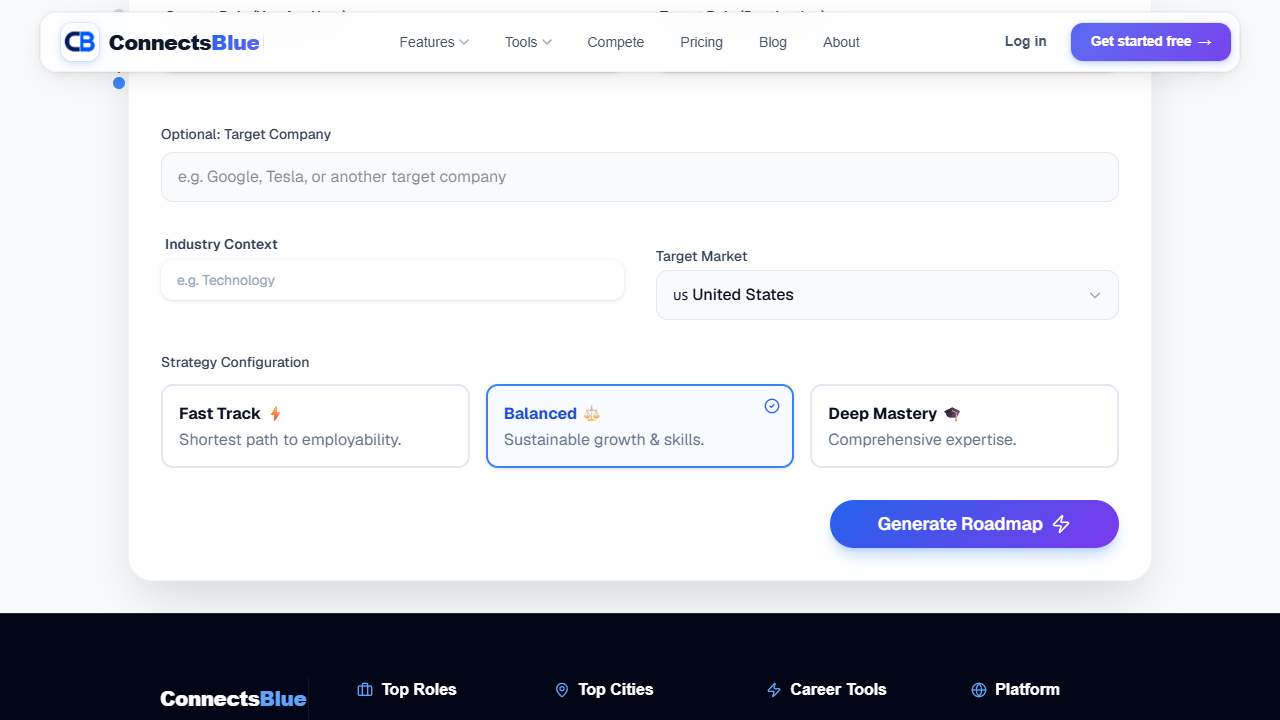
Screenshot captured from the public ConnectsBlue product experience.
Before applying
Before applying during a career transition
Use this checklist to translate prior work, name recruiter doubts, build proof, and test the target role before scaling applications.
- Choose one target role family for the transition.
- Map prior responsibilities to target-role signals.
- Name the biggest recruiter doubt.
- Build one proof asset for the gap.
- Align resume, profile, and interview story.
- Review response quality before increasing application volume.
Transition FAQ
Questions candidates ask about career transitions
How do I explain a career transition?
Explain the prior work you are carrying forward, the target role signal it supports, the proof you have built, and why the move is practical now.
Should I hide unrelated experience?
No, but rewrite it around transferable decisions, outcomes, systems, customers, or constraints. Remove only details that distract from the target role.
What proof helps most during a transition?
A project, portfolio note, process improvement, case study, certification with application, or interview story that answers the main recruiter doubt.
How many roles should I apply to first?
Start with a small representative batch. Use the response pattern to decide whether the story, resume, or target role needs adjustment.
Make it concrete
Make the transition easy to believe
Translate old work, build proof for the biggest gap, and test the story before applying widely.
Related Guides
Continue with practical articles on the same theme
Career Change at 30: Plan the Move With Evidence
An age-specific career-change guide for candidates who need to protect income, explain transferable proof, and test a new role before making a risky move.
Protect Your Mental Health During a Long Job Search
A practical guide for protecting energy during a long search by limiting low-quality applications, tracking signals, and keeping follow-up habits sustainable.
Remote Work Salaries: How Global Pay Bands Are Changing
This salary guide keeps negotiation practical: know the range, document impact, understand tradeoffs, and decide what matters before the call.