How to Find High-Quality Remote Tech Jobs
A remote tech job-search guide for comparing listings, proving distributed-work readiness, checking employer quality, and avoiding low-signal remote roles.
Remote tech roles vary widely: some are truly distributed, some are hybrid with exceptions, and some are low-quality listings using remote language to attract volume.
What to prepare first
- Filter remote jobs by hiring location, time zone, salary basis, work model, and team maturity before applying.
- Show distributed-work proof in the resume: documentation, handoffs, project ownership, async updates, and measurable output.
- Ask practical remote questions before late-stage interviews, especially around meetings, onboarding, equipment, and manager expectations.
- Use a tracker to compare response quality across job boards, company sites, communities, and referrals.
Listing quality
Read the remote listing before reading the title
A remote job title can hide important constraints. The listing may require a specific country, office visits, overlapping hours, contractor status, or salary pegged to local bands.
Before applying, check whether the company explains how remote work actually runs. Look for onboarding details, communication norms, collaboration tools, and how performance is measured.
- Check whether remote means global, country-specific, or hybrid.
- Look for salary basis: local market, global band, contractor, or employer-of-record.
- Review time-zone overlap and meeting expectations.
- Avoid listings that hide company identity, pay model, or work location rules.
Remote evidence
Show that you can work without constant visibility
Remote teams trust candidates who can make work visible without needing constant supervision. That proof should appear in project bullets, portfolio notes, and interview examples.
A remote-ready resume should mention documentation, handoffs, incident ownership, written updates, cross-time-zone work, or measurable delivery where those facts are true.
| Remote signal | Resume proof | Interview proof |
|---|---|---|
| Async communication | Decision notes, status updates, documentation | A story about reducing confusion without a meeting |
| Ownership | Delivered feature, test plan, analysis, or customer fix | A story about handling blockers independently |
| Collaboration | Worked with product, design, support, or client teams | A story about clarifying expectations across functions |
| Reliability | SLA, sprint, release, or support metric | A story about predictable follow-through |
Interview checks
Ask questions that reveal how remote work really operates
Remote interviews should not only prove candidate fit. They should reveal whether the team can support distributed work in a healthy way.
Use ConnectsBlue to compare roles and save notes from each conversation so remote-friendly language can be checked against real manager answers.
- Ask how new hires are onboarded in the first thirty days.
- Ask which decisions are documented and where they live.
- Ask what meeting load looks like across time zones.
- Ask how performance is evaluated for distributed workers.
Product proof
Career GPS shown inside ConnectsBlue
The guide connects planning advice to the real roadmap surface candidates use to define target roles, skill gaps, milestones, and next actions.
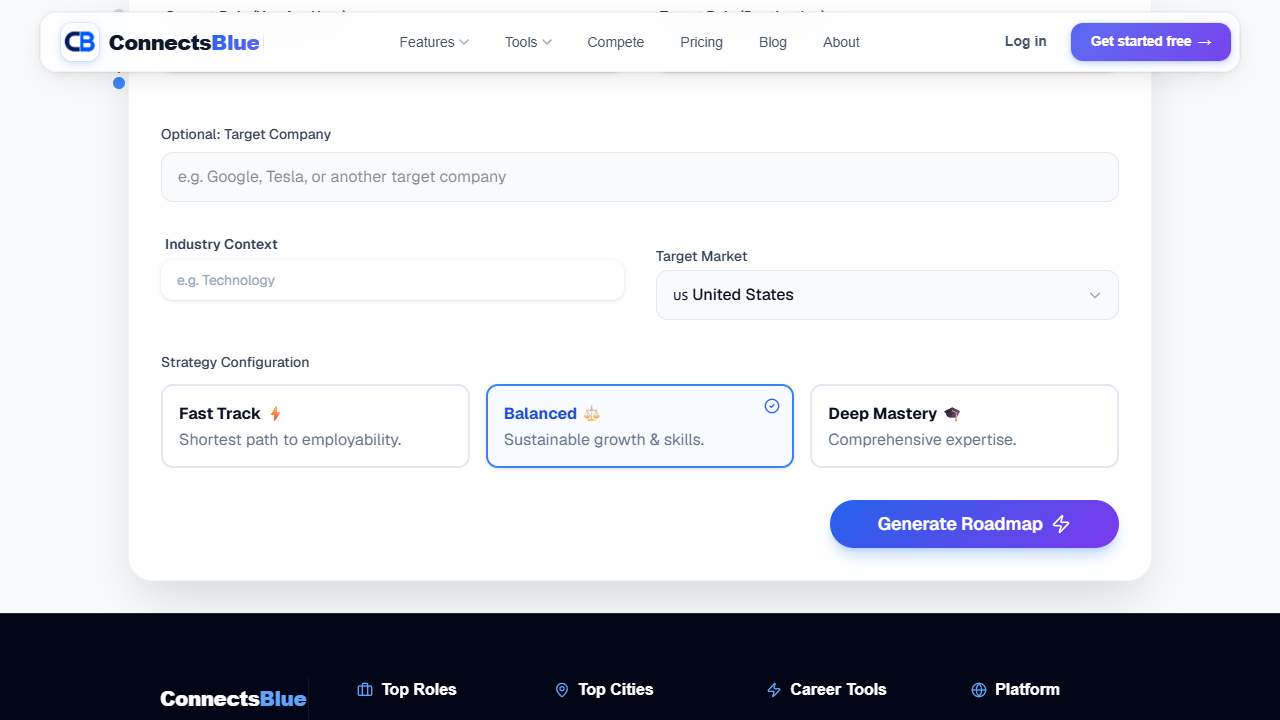
Screenshot captured from the public ConnectsBlue product experience.
Before applying
Before applying to a remote tech role
Use this checklist to confirm the role is truly remote, the employer is specific, and your application proves distributed-work readiness.
- Confirm country, time-zone, and hybrid requirements.
- Check salary basis, employment type, and equipment support.
- Add true distributed-work proof to the resume.
- Prepare one interview story about async ownership.
- Track which remote sources produce credible replies.
- Ask remote operating questions before final rounds.
Remote FAQ
Questions candidates ask about remote tech jobs
How do I know whether a remote tech job is real?
Look for company identity, hiring location, time-zone expectations, salary basis, team practices, and a clear interview process. Vague listings with no operating detail deserve caution.
What should I put on my resume for remote roles?
Use real examples of documentation, async updates, ownership, cross-functional work, customer support, incident handling, or delivery without constant supervision.
Are remote jobs always paid globally?
No. Many companies use local salary bands or country-specific employment rules. Compare base pay, benefits, currency, taxes, and contractor risk before judging the offer.
Where does ConnectsBlue fit in a remote search?
Use it to compare remote roles, prepare role-specific evidence, track applications, and keep interview notes tied to each opportunity.
Use the workflow
Apply where the remote model is clear
Prioritize roles with transparent location rules, clear team practices, and enough context to judge fit before applying.
Related Guides
Continue with practical articles on the same theme
Protect Your Mental Health During a Long Job Search
A practical guide for protecting energy during a long search by limiting low-quality applications, tracking signals, and keeping follow-up habits sustainable.
Remote Work Salaries: How Global Pay Bands Are Changing
This salary guide keeps negotiation practical: know the range, document impact, understand tradeoffs, and decide what matters before the call.
Networking in the Digital Age Without Sounding Transactional
This networking guide focuses on credibility: who to contact, what to say, when to follow up, and how to keep the relationship useful.