ConnectsBlue vs Glassdoor vs Wellfound: Which Job Platform Fits Your Search?
A comparison guide for choosing when to use ConnectsBlue, Glassdoor, and Wellfound across discovery, company research, salary checks, and application preparation.
Glassdoor is strongest when candidates need employer reviews, salary context, and interview anecdotes, but review quality varies by company and recency.
What to take from this guide
- Use Glassdoor for company and compensation context, then verify with current conversations.
- Use Wellfound for startup discovery and founder-backed role context where it is available.
- Use ConnectsBlue to prepare and track serious opportunities once the candidate has a role target.
- Compare platforms by the decision they support, not by the number of visible features.
Platform roles
Give each platform a job in the search
The comparison becomes useful when each platform has a clear role. Candidates can use one tool for discovery, another for company context, and another for preparation without treating every tab as a full workflow.
Start by deciding whether the current problem is finding roles, judging companies, preparing evidence, or following up.
| Platform | Best use | Watch-out |
|---|---|---|
| Glassdoor | Reviews, salary context, interview anecdotes | Old or polarized reviews can distort judgment |
| Wellfound | Startup discovery and early-stage role context | Coverage depends on market and company activity |
| ConnectsBlue | Resume, interview, role tracking, and preparation workflow | Works best after the candidate defines a target role |
Research step
Use reviews and salary notes as prompts, not final truth
Company reviews and salary posts can reveal useful questions, but they should not be treated as complete evidence. Teams change, pay bands move, and interview processes vary by role.
Turn research into interview questions: how the team measures work, what the role owns, how managers support remote or hybrid work, and how compensation is structured.
- Check review recency and role similarity.
- Compare salary notes with location, level, and benefits.
- Use interview anecdotes to prepare questions, not assumptions.
- Save research notes beside the role so they are available before calls.
Preparation workflow
Move serious roles into a workspace
Once a role looks worth pursuing, the candidate needs a different workflow: tailor the resume, prepare examples, practice likely questions, and track follow-ups.
That is where ConnectsBlue fits. It does not need to replace research platforms; it should reduce the gap between finding a role and preparing well for it.
- Save the target role and its constraints.
- Match resume proof to the job description.
- Practice interview answers against the role level.
- Track replies, notes, and next actions in one place.
Product proof
Career GPS shown inside ConnectsBlue
The guide connects planning advice to the real roadmap surface candidates use to define target roles, skill gaps, milestones, and next actions.
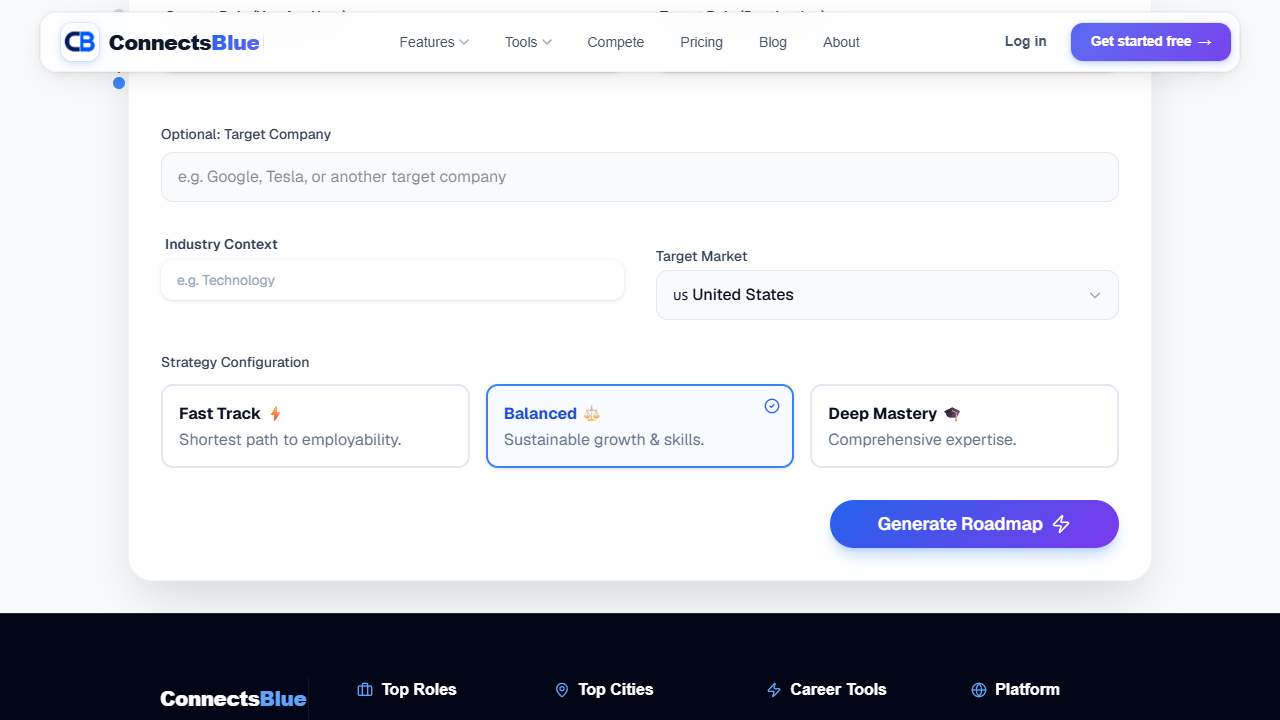
Screenshot captured from the public ConnectsBlue product experience.
Before choosing
Before choosing a job-search platform
Use this checklist to separate discovery, company research, salary context, preparation, and follow-up before adding another tool.
- Name whether the current gap is discovery, research, preparation, or tracking.
- Use reviews and salary notes to create interview questions.
- Move serious roles into a preparation workflow.
- Keep resume evidence tied to the target role.
- Track follow-ups and outcomes after each application.
- Remove tools that duplicate the same saved jobs without improving decisions.
Platform FAQ
Questions candidates ask about ConnectsBlue, Glassdoor, and Wellfound
Is ConnectsBlue a replacement for Glassdoor?
No. Glassdoor can be useful for reviews and salary context. ConnectsBlue is better used as the workspace for preparing and tracking serious roles.
When should I use Wellfound?
Use Wellfound when startup discovery and early-stage company context matter. Verify role expectations through current conversations before relying on a listing alone.
How should I combine these tools?
Use Glassdoor and Wellfound for research and discovery, then use ConnectsBlue for resume work, interview preparation, role tracking, and follow-up discipline.
Which platform should I start with?
Start with the problem. If you need roles, use discovery sources. If you need company context, research. If you already have targets, prepare and track them.
Next step
Use each platform for the decision it supports
Keep discovery, research, preparation, and tracking connected without forcing one tool to do every job.
Related Guides
Continue with practical articles on the same theme
ConnectsBlue vs Job Boards: What to Use When
A platform comparison guide for deciding when to use job boards, networks, resume tools, interview practice, salary research, and ConnectsBlue in one workflow.
Protect Your Mental Health During a Long Job Search
A practical guide for protecting energy during a long search by limiting low-quality applications, tracking signals, and keeping follow-up habits sustainable.
How Applicant Tracking Systems Read Your Resume
A recruiter-focused walkthrough for understanding how applicant tracking systems read resumes, written around scan time, ATS parsing, plain formatting, and proof that survives a human review.