Interview preparation
Mock Video Interview Practice: Build Confidence Before the Real Call
Mock video practice is useful when it feels close enough to a real screening call to reveal what needs work, but low-pressure enough to let you repeat the answer. The goal is not to memorize perfect lines. The goal is to make your examples easier to hear, review, and improve.
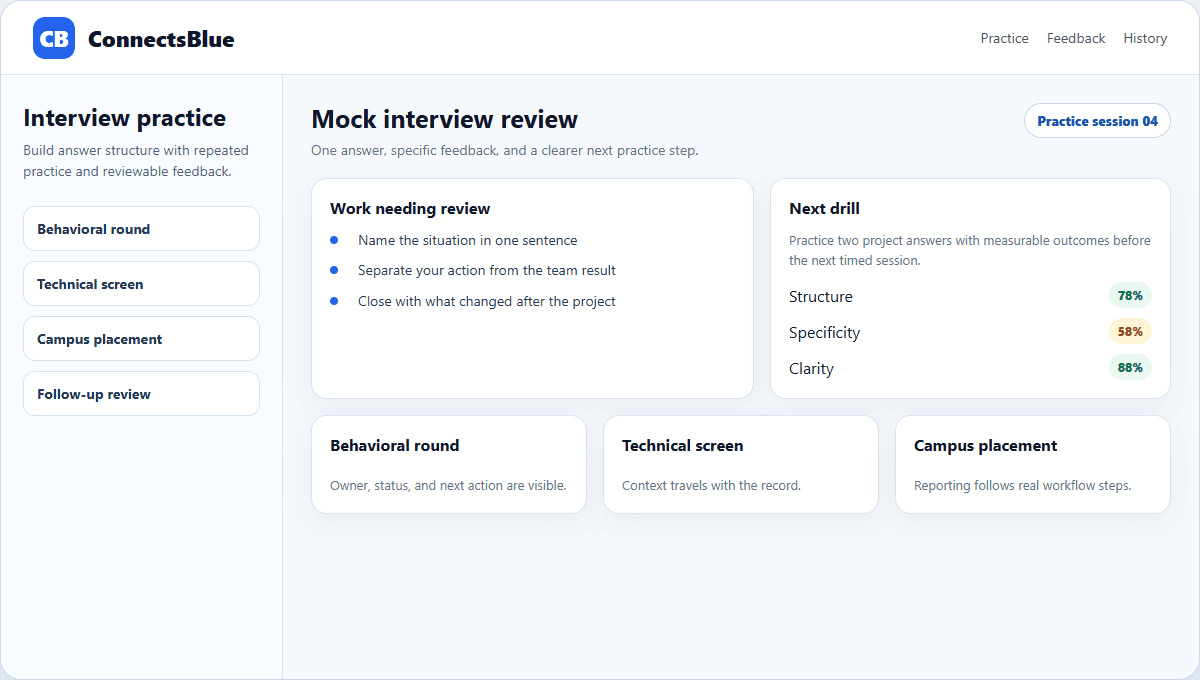
Product view: review notes after a mock interview practice session.
When mock video practice is worth using
Video practice helps most when the interview format itself is part of the challenge. A strong written answer can still feel scattered once the camera is on, the timer is visible, and the room is quiet. Recording a short answer exposes simple issues that are easy to miss in written prep: weak openings, long detours, poor lighting, rushing, and examples that need more context.
The best sessions are specific. Pick the role, choose two likely questions, record the answer, then review one thing at a time. That keeps practice practical instead of turning preparation into another long checklist.
What to rehearse before recording
Start with the parts that make a video call feel professional. Your background should be quiet, your face should be lit from the front, and your camera should sit close to eye level. Keep a few notes nearby, but use them as prompts rather than a script.
Recorded screening rounds
Practice a concise opening, keep answers under time, and learn how your camera framing changes the impression of the answer.
Behavioral questions
Turn work examples into clear situation, action, and result stories without sounding rehearsed or over-polished.
Campus placement interviews
Prepare first job answers around projects, internships, coursework, and team situations when professional experience is limited.
A simple 30-minute practice session
Long practice blocks are hard to repeat. A short session is easier to finish, easier to compare with the next attempt, and easier to fit before a real call.
Set the room
Check lighting, background, microphone, eye line, and whether notes are visible but not distracting.
Answer two questions
Record one behavioral answer and one role-specific answer. Keep each answer focused enough to review.
Review the recording
Look for pace, filler words, unclear examples, missing context, and places where the answer trails off.
Write the next drill
Choose one thing to improve in the next session instead of trying to fix everything at once.
What useful feedback should include
Feedback is only helpful when it points to the next edit. Broad comments like "be confident" do not help much. Better feedback names the problem, shows where it happened, and gives one specific adjustment for the next recording.
Review checklist
- Does the first sentence answer the question directly?
- Is the example specific enough for an interviewer to trust it?
- Did the answer explain your contribution, not only the team result?
- Is there a clear outcome, learning, or follow-up action?
- Would the answer still make sense if the interviewer had not seen your resume?
How students and early-career candidates can use it
Students often have fewer workplace stories, so the practice should focus on usable material: academic projects, internships, volunteer work, competitions, leadership moments, and group assignments. A good answer explains the context quickly, names the personal contribution, and closes with what changed because of the work.
For campus placements, rehearse one introduction, one project explanation, one challenge example, and one question for the interviewer. Those four areas cover a large part of early screening conversations without forcing the candidate into generic memorized answers.
After the practice session
Save the next action while the recording is fresh. The most useful note is usually small: shorten the opening, add the result earlier, slow down after the question, or choose a stronger example. Repeat the same question once more only after the adjustment is clear.
Mock video practice works best as a review habit. It should make the real interview feel more familiar, not turn the candidate into someone who sounds manufactured.
How to review the recording without over-polishing it
Watch the recording twice. On the first pass, ignore small wording mistakes and ask whether the interviewer would understand the example, your role, and the result. On the second pass, look at delivery: whether you rushed, looked away for too long, repeated the same filler word, or ended without a clear point.
Do not rewrite the whole answer after every recording. Choose one edit that would make the next attempt easier to follow. For example, add one sentence of context before a project story, name the trade-off in a decision, or move the result closer to the beginning. That keeps practice natural and gives you a visible reason to record again.
Candidates preparing for campus placements can use the same review method with peers or mentors. Ask them to point out where the answer became hard to follow, not to judge whether it sounded impressive. The useful question is simple: would this answer help an interviewer make a fair next decision?
Keep the next practice session specific
Pick one role, one interview stage, and one answer pattern to improve. That is enough for a useful session.
Related reading
Live Voice Interview Practice: When Speaking Out Loud Helps
Use voice-only practice when you need better pacing, clearer examples, and fewer filler words.
STAR Method Practice for Behavioral Interviews
A practical way to structure examples without turning every answer into a script.
Interview Preparation Roadmap for Indian Job Seekers
A stage-by-stage plan for campus placements, IT services rounds, and product company interviews.