Real-Time Interview Practice on ConnectsBlue
Real-Time Interview Practice on ConnectsBlue helps candidates rehearse answers that sound specific, calm, and evidence-based instead of memorized from a question bank.
Built for Indian freshers, lateral hires, return-to-work candidates, and remote job seekers.
What to decide before acting
- Choose one role, one interview round, and one answer to improve before starting a session.
- Use the recording and transcript to find rambling, missing evidence, and weak follow-up answers.
- Replace polished but vague lines with role context, constraints, trade-offs, and outcomes.
- Repeat the session only after changing one specific answer, not the whole interview style.
Starting point
Choose the interview scenario before opening the tool
A useful rehearsal starts with a real target: the job description, expected round type, seniority level, and the answer the candidate wants to improve.
Indian interviews often mix communication, technical depth, project ownership, notice period, CTC, and location expectations. A practice round should reflect those constraints instead of asking generic questions in isolation.
The reader should leave with one concrete change, such as a tighter project story, a clearer trade-off, or a better answer to a follow-up question.
- Pick a role family before starting the session.
- Name the interview round: recruiter screen, technical, manager, HR, or campus panel.
- Write down two answers that currently feel vague or too long.
- Keep the first practice goal narrow enough to review in ten minutes.
Selection signals
What recruiters need to hear in a practiced answer
Recruiters and interviewers are not only listening for confidence. They are checking whether the candidate can explain decisions, constraints, ownership, and results without drifting into memorized language.
For interview preparation, the evidence usually includes specific examples, role context, measurable outcomes, trade-offs, and calm answers to compensation and joining questions.
| Interview signal | What to prepare | Weak version to avoid |
|---|---|---|
| Role fit | One example that matches the target job requirement | A broad claim about being passionate or hardworking |
| Ownership | What the candidate decided, changed, shipped, or improved | A team story with no personal contribution |
| Judgment | Trade-offs, constraints, and why a choice was reasonable | A perfect-sounding answer with no tension |
| Readiness | Notice period, location, work mode, salary range, and joining timeline | Late-stage surprises after a strong interview |
Candidate workflow
A weekly rehearsal workflow that stays human
Set aside one weekly review block. Choose a target role, run one timed session, read the transcript, and revise one answer before practicing again.
ConnectsBlue works best as part of that loop: rehearse the conversation, inspect what was actually said, and compare the next version against real recruiter or panel feedback.
- Monday: choose the role and round type.
- Tuesday: write two short proof notes from work, internship, project, or coursework.
- Wednesday: run one practice session and save the transcript.
- Friday: revise the weakest answer and repeat only that scenario.
Quality filter
Use the recording to find one fix at a time
Advice becomes useful when it tells the candidate what to change next. Listen for the answer that sounds impressive but cannot be checked, then replace it with a role, a fact, a constraint, or a next step.
The best practice habit is not perfection. It is building answers that survive follow-up questions because the candidate knows the work behind the words.
- Remove adjectives unless they are supported by a concrete example.
- Replace long background stories with situation, decision, trade-off, and result.
- Check whether each answer could be defended if the interviewer asks for detail.
- Keep one improvement note for the next session instead of rewriting every response.
Product proof
Interview Practice shown inside ConnectsBlue
The article links preparation advice to the real practice flow for role-based mock interviews, answer review, and confidence building.
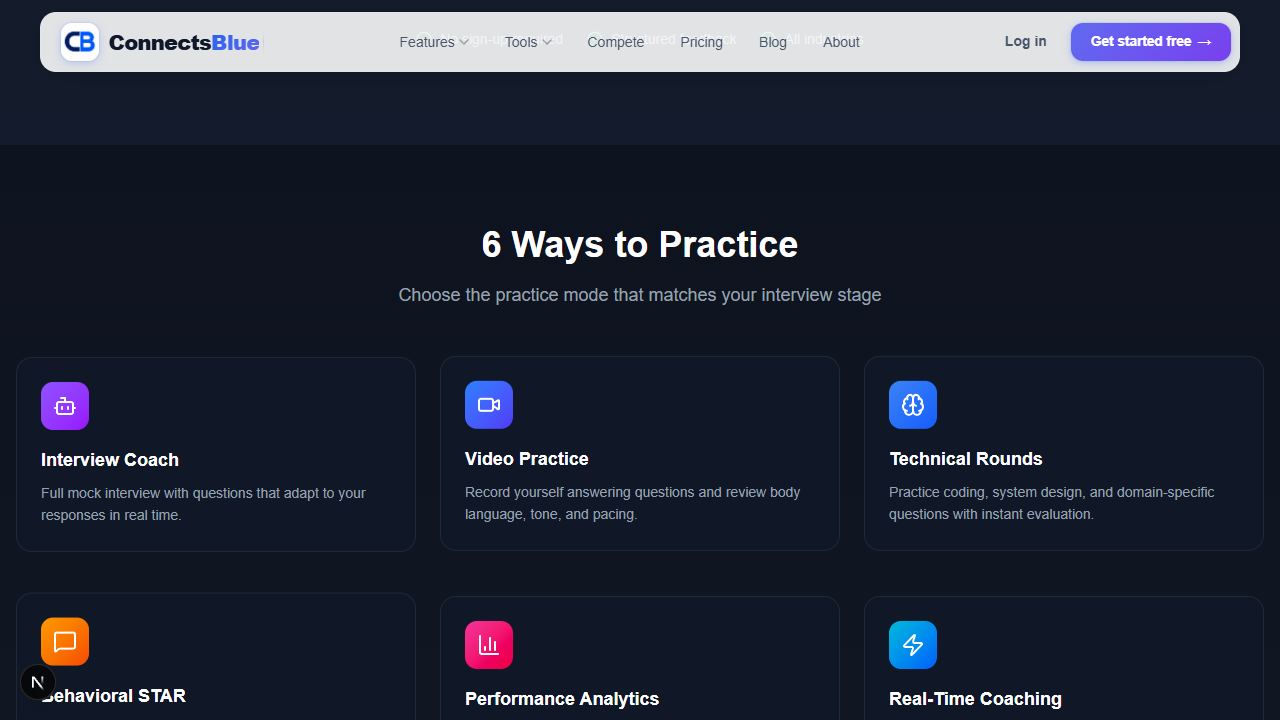
Screenshot captured from the public ConnectsBlue product experience.
Practice checklist
Review the session before repeating it
Use the checklist to turn one practice round into a practical improvement loop. The goal is to make the next answer clearer, shorter, and easier to verify.
- Read the target job description and mark the top five selection signals.
- Choose the interview round you are preparing for.
- Prepare two examples from work, internship, project, coursework, or campus leadership.
- Review the transcript for rambling, missing evidence, and filler words.
- Rewrite one answer in the candidate voice before practicing again.
- Compare the next session with recruiter or panel feedback after the real interview.
Questions before applying
Common questions about interview practice
What is the most important part of interview preparation?
The most important part is evidence. Candidates should prepare specific examples, role context, measurable outcomes, trade-offs, and calm answers to practical questions about compensation, joining, location, and availability.
How should Indian candidates use this workflow?
Indian interviews often combine technical depth, communication, project ownership, notice period, expected CTC, and location fit. Candidates should prepare those answers early instead of waiting until the final round.
Should candidates rely completely on ConnectsBlue tools?
No. Use the tools to structure, record, and review practice. The final answer should still be checked by the candidate and grounded in truthful personal experience.
How is this different from memorizing interview answers?
Memorized answers usually fail when the interviewer asks a follow-up question. This workflow helps candidates practice the evidence behind an answer so they can adapt naturally in the real conversation.
Next action
Practice one answer, then review it like evidence
Start with a target role, record one focused session, and change one answer before repeating the round.
Related Guides
Continue with practical articles on the same theme
AI Video Interview Platform Guide for Recruiters
AI Video Interview Platform Guide for Recruiters focuses on interview operations: stage ownership, panel availability, candidate communication, and comparable feedback.
Mock Video Interview Practice: Build Confidence Before the Real Call
Interview preparation for mock video interview features, with attention to role context, concise stories, follow-up questions, and notes to review before the next round.
STAR Method Interview Guide for Behavioral Questions
A behavioral interview guide for turning real work examples into STAR answers with clear context, ownership, trade-offs, and measurable outcomes.