STAR Method Interview Guide for Behavioral Questions
A behavioral interview guide for turning real work examples into STAR answers with clear context, ownership, trade-offs, and measurable outcomes.
STAR answers work only when they are based on real evidence. A neat structure cannot rescue a vague or invented example.
What to test in the market
- Use STAR to organize evidence, not to make every answer sound identical.
- Choose examples with a real constraint, decision, action, and result.
- Prepare follow-up details because interviewers often probe the action and result.
- Keep answers short enough to invite a useful conversation.
Story bank
Build five examples before writing any answer
A strong STAR answer starts before the question is asked. Candidates should prepare a story bank from work, internship, campus projects, customer issues, failures, leadership moments, or process improvements.
Each story should have enough detail to survive follow-up questions.
- Pick examples for conflict, ownership, learning, failure, and teamwork.
- Write the constraint or pressure in one sentence.
- Name the decision the candidate personally made.
- Record a measurable or observable result.
Answer structure
Use each STAR part for a different job
Situation gives context. Task explains responsibility. Action shows judgment and ownership. Result proves what changed.
Weak answers spend too long on background and rush through the candidate action.
| STAR part | Purpose | Common mistake |
|---|---|---|
| Situation | Give just enough context | Long company history |
| Task | Clarify what the candidate owned | Unclear personal responsibility |
| Action | Show decisions, trade-offs, and steps | Team did everything |
| Result | Show outcome and learning | No measurable change or reflection |
Follow-up depth
Prepare for the second question
Interviewers often learn more from the follow-up than from the first answer. They may ask why the candidate chose an approach, what went wrong, or what would change next time.
Use recorded practice to catch answers that sound polished but thin under follow-up pressure.
- Prepare one trade-off for each story.
- Know what changed after the result.
- Be ready to name what you would do differently.
- Avoid making every story sound like a perfect win.
Product proof
Interview Practice shown inside ConnectsBlue
The article links preparation advice to the real practice flow for role-based mock interviews, answer review, and confidence building.
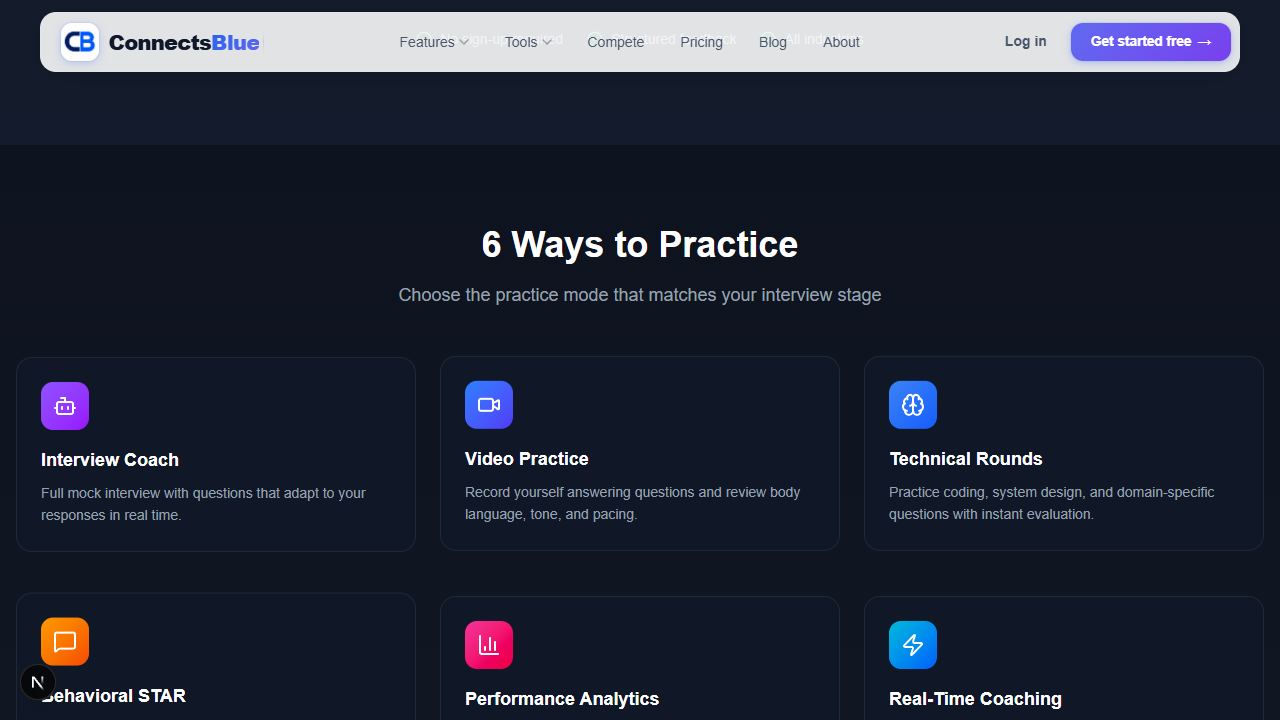
Screenshot captured from the public ConnectsBlue product experience.
Before practice
Before practicing STAR answers
Use this checklist to select truthful examples, define ownership, prepare follow-up depth, and keep answers concise.
- Prepare five story-bank examples.
- Write the situation in one or two sentences.
- Name the task and personal responsibility clearly.
- Spend most of the answer on action and judgment.
- Add a result, learning, or next change.
- Practice one follow-up question for each story.
STAR FAQ
Questions candidates ask about the STAR method
How long should a STAR answer be?
Most answers should be about one to two minutes. Keep context short, explain the action clearly, and leave room for follow-up.
Can I use college projects for STAR answers?
Yes, if the project has real decisions, constraints, teamwork, or outcomes. Explain your own contribution clearly.
What if I do not have a perfect result?
Use the result honestly. A thoughtful lesson or partial improvement can be stronger than a perfect-sounding but vague success story.
Should every behavioral answer use STAR?
STAR is a useful structure, but answers should still sound natural. Use it to organize the story, not to force robotic phrasing.
Review the signal
Use structure without sounding rehearsed
Prepare real examples, then use STAR to make the evidence easier to follow.
Related Guides
Continue with practical articles on the same theme
AI Video Interview Platform Guide for Recruiters
AI Video Interview Platform Guide for Recruiters focuses on interview operations: stage ownership, panel availability, candidate communication, and comparable feedback.
Mock Video Interview Practice: Build Confidence Before the Real Call
Interview preparation for mock video interview features, with attention to role context, concise stories, follow-up questions, and notes to review before the next round.
Interview Preparation Roadmap for Indian Job Seekers
Interview preparation for architecture overview, with attention to role context, concise stories, follow-up questions, and notes to review before the next round.