Interview practice
Interview Practice Guide for Students
A practical way for students to build answer structure, reduce rehearsal gaps, and review interview performance before placement or early-career rounds.
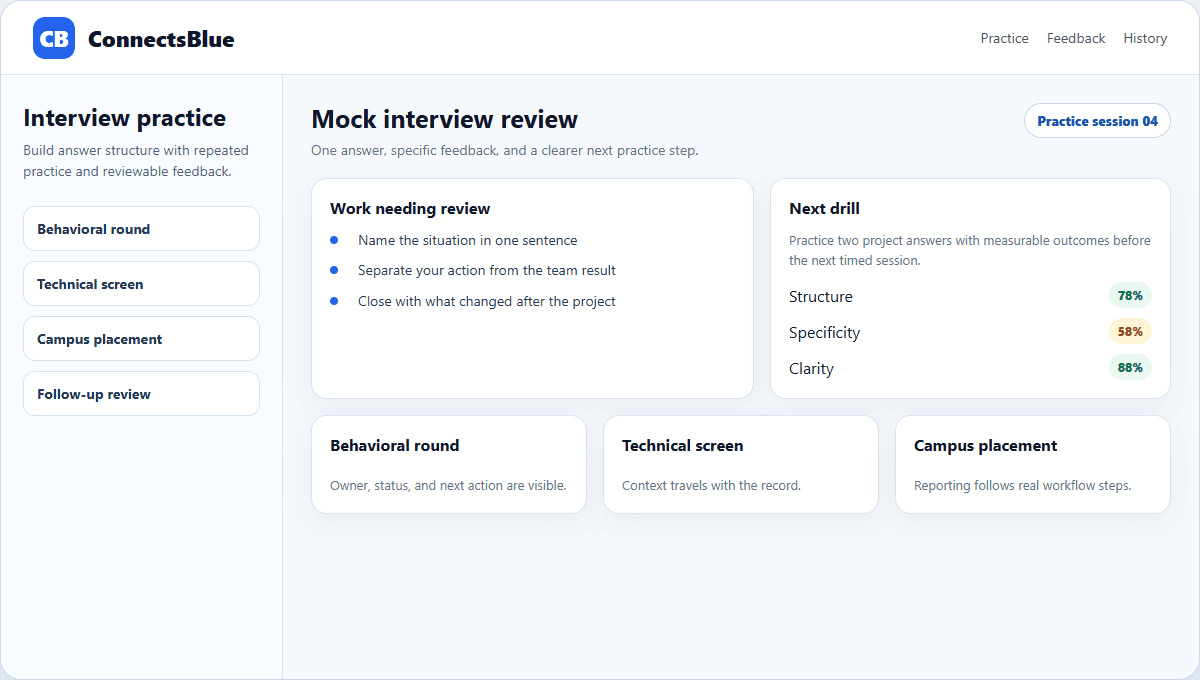
Interview skills improve when practice is repeated, specific, and reviewed. Reading sample answers helps, but it does not replace answering out loud, seeing weak spots, and trying again.
This guide is for students preparing for campus placements, internships, first jobs, or early career transitions. The aim is not to memorize perfect answers. The aim is to build a repeatable way to think under pressure.
Practice design
Separate answer structure from answer content
Many students know the facts but lose the thread while speaking. A strong practice session separates structure from content so the answer has a clear path before details are added.
For behavioral questions, that often means situation, task, action, and result. For technical questions, it may mean problem, approach, tradeoffs, and verification.
Question type
Behavioral
Useful structure
Situation, task, action, result.
What to review
Is the answer specific and complete?
Question type
Project
Useful structure
Problem, role, implementation, outcome.
What to review
Can the student explain ownership clearly?
Question type
Technical
Useful structure
Clarify, solve, test, discuss tradeoffs.
What to review
Does the answer show reasoning, not memorization?
Question type
Company fit
Useful structure
Role interest, evidence, questions.
What to review
Does the answer sound researched and honest?
Feedback
Review one answer at a time
Trying to fix every habit at once makes practice noisy. Start by reviewing one answer for structure, specificity, and clarity. Then repeat the same question with one improvement.
Structure
Does the answer have a beginning, middle, and end, or does it trail off?
Specificity
Does it name a real project, tool, decision, or outcome?
Clarity
Would a listener understand the main point without asking for a restart?
Follow-up readiness
Can the student answer why they made a choice or what they would do differently?
Routine
Use short sessions more often
A useful routine does not need to be dramatic. Two focused answers a day can improve structure faster than one long session where every question becomes a blur.
Students should keep a small answer bank: strongest project story, conflict story, learning story, technical explanation, and one question to ask the interviewer.
- Practice one behavioral and one role-specific question per session.
- Save the best version of each answer after review.
- Repeat weak answers instead of only moving to new questions.
- Do one timed session before a real interview to test pacing.
Modes
Match the practice mode to the interview stage
Stage
Early prep
Practice mode
Typed or written answer review.
Why it helps
Helps students build structure without performance pressure.
Stage
Placement week
Practice mode
Timed mock interview.
Why it helps
Tests pacing, recall, and ability to recover from weak answers.
Stage
Video round
Practice mode
Recorded response review.
Why it helps
Shows eye contact, pace, and whether answers feel natural.
Stage
Final round
Practice mode
Follow-up question drills.
Why it helps
Prepares students to defend decisions and explain tradeoffs.
Outcome
The goal is calm recall, not scripted perfection
A student who memorizes answers can sound polished until the interviewer asks a follow-up. A student who has practiced structure can adapt because they know how to organize a new answer quickly.
Implementation notes
How to use this guide in a real hiring workflow
Use this article as a working review document, not just a buying overview. Compare interview practice guide for students with the way your team currently works, then fix the places where ownership, evidence, or candidate communication is unclear.
- Name the owner for the stage before changing configuration.
- Define the evidence recruiters and managers should capture.
- Review candidate-facing messages for clarity and tone.
- Measure whether the change reduced delay, rework, or ambiguity.
Student questions
Interview Practice Guide for Students FAQ
How should students start interview practice?
Start with a small set of common behavioral, project, and role-specific questions. Practice one answer, review it, improve it, and repeat before adding many new questions.
Is written practice enough for interviews?
Written practice helps structure answers, but students should also speak answers aloud or record timed responses before real interviews.
What should students review after each mock interview?
Review structure, specificity, clarity, pacing, and follow-up readiness. One concrete improvement per answer is more useful than vague overall feedback.
Next step
Practice one answer, then improve it.
Use ConnectsBlue Interview Practice to rehearse role-specific questions, review weak spots, and build a calmer interview routine.
Practice an interview