ATS review
ATS Resume Optimization Guide for Students
A student-focused guide to resume parsing, role keywords, section names, and format checks before submitting applications.
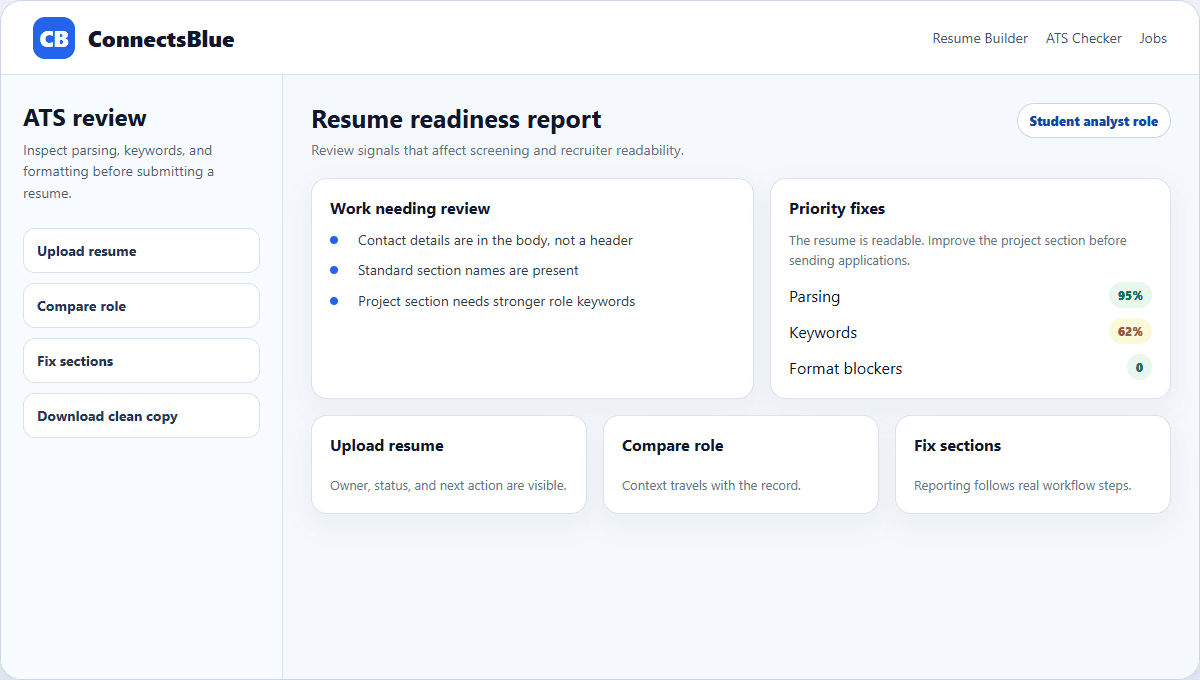
Student resumes often fail for ordinary reasons: unclear sections, missing role language, contact details in the wrong place, or project bullets that do not explain impact.
ATS optimization is not about tricking software. It is about making your resume readable, complete, and aligned with the role so a recruiter can understand your fit faster.
Parsing
First make sure the document can be read
A resume can look polished and still parse badly. Screening systems extract text, identify sections, and compare the document to job requirements. Anything that blocks extraction creates avoidable risk.
Contact details
Put name, email, phone, location, portfolio, and profile links in the main document body.
Section headings
Use labels that both recruiters and systems expect: Education, Projects, Experience, Skills, Certifications.
Layout
Avoid tables, text boxes, image-only resumes, and complex multi-column designs for standard applications.
File type
Use the employer-requested format. If no format is specified, keep a clean PDF and editable DOCX ready.
Keywords
Mirror the role without stuffing the resume
Keyword matching works best when the terms appear inside real evidence. A skills list can help, but a project or internship bullet is stronger because it shows context.
If the job description asks for SQL, dashboards, stakeholder reporting, or Python, the resume should show where you used those skills rather than placing them in a random list.
Job signal
SQL
Weak resume use
Listed only under skills.
Stronger resume use
Used SQL to clean and join placement records for a dashboard project.
Job signal
Communication
Weak resume use
Says good communicator.
Stronger resume use
Presented weekly project updates to faculty mentor and team.
Job signal
Data analysis
Weak resume use
Mentions data analysis broadly.
Stronger resume use
Analyzed survey data and summarized findings for a student operations project.
Job signal
Frontend
Weak resume use
Lists React without context.
Stronger resume use
Built a React interface for registration, status tracking, and admin review.
Student evidence
Translate academic work into recruiter-readable proof
Students often underestimate coursework, labs, hackathons, capstone projects, and campus responsibilities. These can be useful when they are written as work examples instead of class descriptions.
The question is not whether the work was paid. The question is whether it shows skill, ownership, judgment, and completion.
- Name the problem the project solved.
- Mention the tools only when they mattered to the outcome.
- Add scale when real: users, records, pages, teammates, duration, or response time.
- Connect the work to the target role instead of listing every academic exercise.
Review flow
Fix blockers before rewriting the whole resume
Issue
Unreadable layout
Why it matters
Good content may never be parsed correctly.
Candidate action
Move to a single-column document and retest.
Issue
Missing role terms
Why it matters
The resume may look unrelated to the opening.
Candidate action
Add real project or internship evidence using the role language.
Issue
Generic bullets
Why it matters
Recruiters cannot see ownership or outcome.
Candidate action
Rewrite with action, scope, and result.
Issue
Too many versions
Why it matters
Tracking becomes messy and inconsistent.
Candidate action
Keep one base resume and a few targeted variants.
Human review
Passing a screen is only the first test
A readable resume still has to persuade a person. After the technical checks, read the document as a recruiter would: title, summary, strongest evidence, role fit, and whether the candidate can explain the work.
Implementation notes
How to use this guide in a real hiring workflow
Use this article as a working review document, not just a buying overview. Compare ats resume optimization guide for students with the way your team currently works, then fix the places where ownership, evidence, or candidate communication is unclear.
- Name the owner for the stage before changing configuration.
- Define the evidence recruiters and managers should capture.
- Review candidate-facing messages for clarity and tone.
- Measure whether the change reduced delay, rework, or ambiguity.
Candidate questions
ATS Resume Optimization Guide for Students FAQ
What does ATS optimization mean for students?
It means using clear formatting, standard section names, role-relevant keywords, and specific project or internship evidence so the resume can be parsed and reviewed correctly.
Should students use the exact words from a job description?
Use important role terms when they honestly match your experience. Avoid keyword stuffing or adding skills you cannot discuss in an interview.
Is a designed resume bad for ATS?
Not always, but heavy design, tables, icons, images, and multi-column layouts can create parsing problems. Keep a clean application version ready.
Next step
Check the resume before you send it.
Use ConnectsBlue ATS Checker to review parsing, role keywords, and basic formatting issues before submitting applications.
Check resume readiness