Source attribution
Source of Hire Tracking Guide for Recruiters
How to understand which channels create qualified pipeline, not just which channels create the most applications.
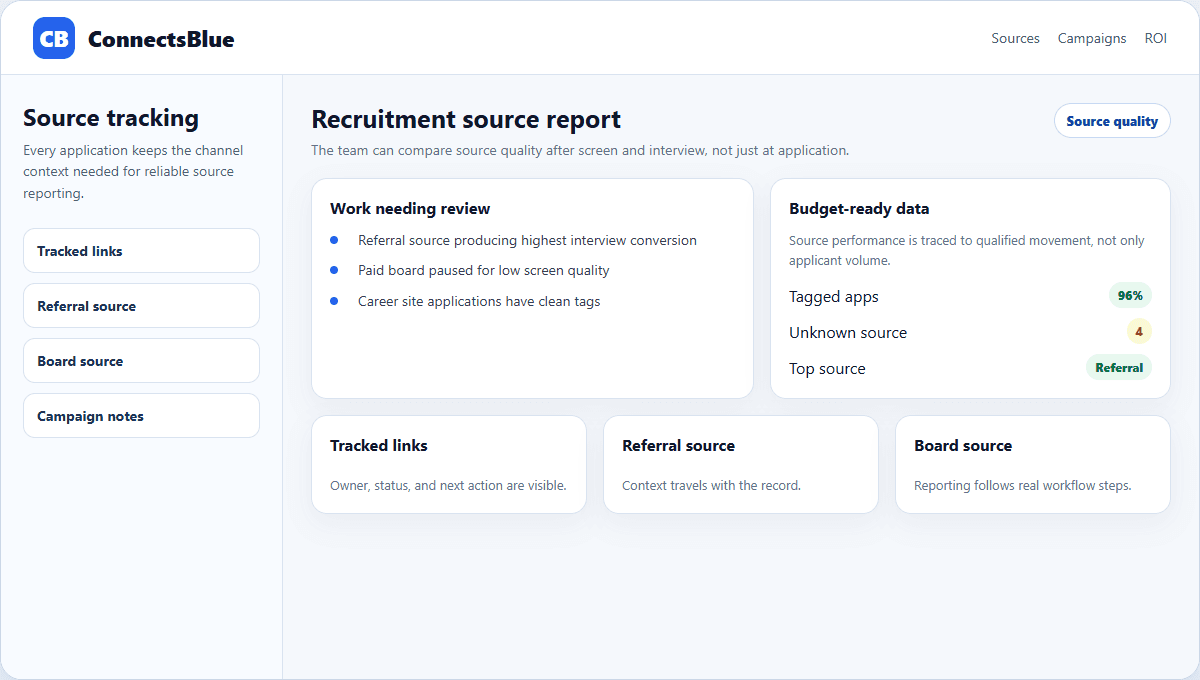
Source tracking only helps when the team can trust it. If every candidate becomes "job board" or "manual upload," the report cannot explain which channels deserve more time, budget, or follow-up.
The useful version follows a candidate from first touch to outcome. It separates raw application volume from qualified screens, interviews, offers, and hires.
Definition
Capture source when the relationship starts
A source should describe where the candidate relationship began: career site, referral, agency, recruiter outreach, event, campus drive, job board, internal rediscovery, or imported contact list.
Do not wait until offer stage to add source data. By then, recruiters are guessing from memory and the report becomes a story about administration instead of hiring.
- Store original source separately from the latest touchpoint.
- Track recruiter-sourced candidates without overwriting referral or event history.
- Keep agency submissions and direct applicants distinct.
- Make the source field required at import, application, or outreach creation.
Quality
Report channel quality by movement, not volume
Signal
Applications
What it tells you
How much interest a channel creates.
Poor interpretation
Assuming high volume means high quality.
Signal
Screens
What it tells you
Whether profiles meet basic role criteria.
Poor interpretation
Counting screens without recording outcomes.
Signal
Interviews
What it tells you
Whether managers see enough evidence to invest time.
Poor interpretation
Ignoring panel capacity and feedback delay.
Signal
Offers
What it tells you
Whether a source produces candidates who survive the full process.
Poor interpretation
Only reporting final hires.
Governance
Give each source an owner and review rhythm
Source tracking becomes actionable when each channel has an owner. Someone should know why LinkedIn outreach is slowing, why one agency produces noisy profiles, or why referrals are strong for one role family and weak for another.
Career site
Review role clarity, application drop-off, stale jobs, and employer-brand questions.
Referrals
Track employee owner, role fit, and whether referrals receive faster review.
Agencies
Compare submitted candidates against screen and interview conversion.
Job boards
Separate broad reach from candidates who actually move forward.
Decision
Use source data to change the sourcing plan
The point of source reporting is not to admire a chart. It is to decide where to spend recruiter time this week: pause a low-fit board, brief an agency, ask for targeted referrals, or reopen a past-candidate search.
Implementation notes
How to use this guide in a real hiring workflow
Use this article as a working review document, not just a buying overview. Compare source of hire tracking guide for recruiters with the way your team currently works, then fix the places where ownership, evidence, or candidate communication is unclear.
- Name the owner for the stage before changing configuration.
- Define the evidence recruiters and managers should capture.
- Review candidate-facing messages for clarity and tone.
- Measure whether the change reduced delay, rework, or ambiguity.
Questions teams ask
Source of Hire Tracking Guide for Recruiters FAQ
What is source of hire tracking?
It is the practice of recording where candidate relationships start and measuring how each source performs through screen, interview, offer, and hire stages.
Should original source and latest source be separate?
Yes. Original source preserves attribution, while latest source explains the most recent interaction or campaign touch.
Which source metric is most useful?
Qualified movement is usually more useful than raw application volume because it shows which channels create candidates the team can actually evaluate.
Next step
Know which channels create real pipeline.
Use ConnectsBlue to keep source attribution tied to candidate movement, recruiter ownership, and hiring outcomes.
View employer tools