Past candidate search
Candidate Rediscovery Guide for Recruiters
How to find qualified past applicants without treating your ATS like a forgotten archive.
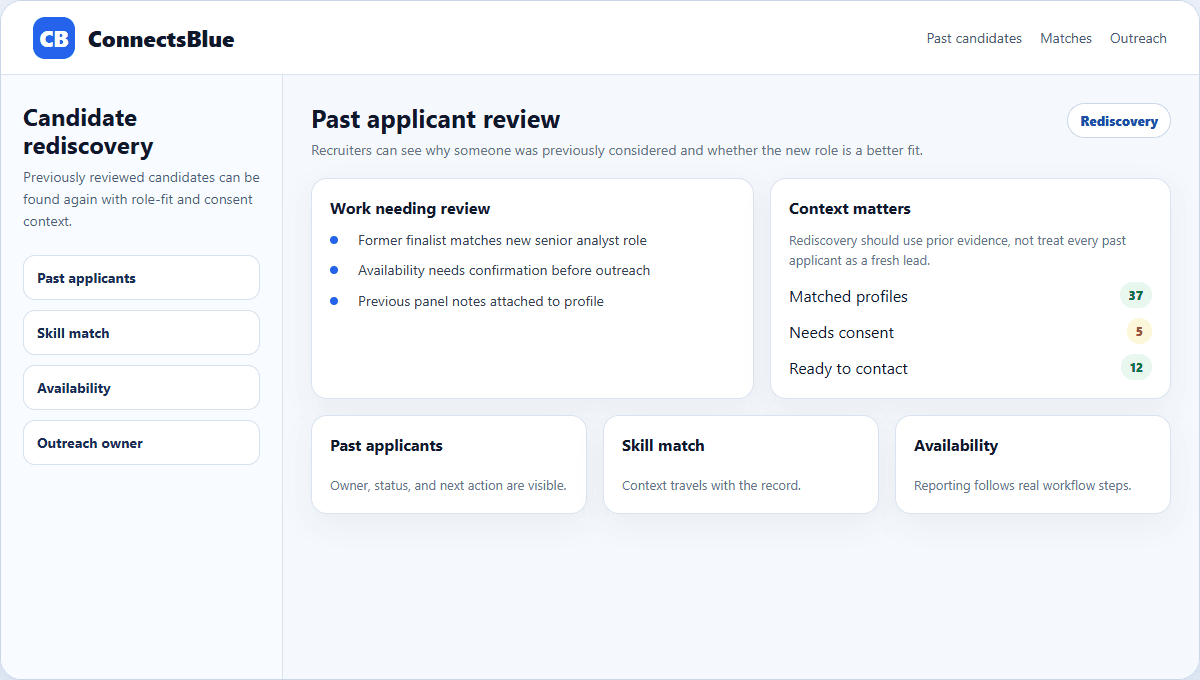
Past applicants are often the warmest part of the recruiting database. Some were finalists, some were too early, and some missed timing rather than ability.
Candidate rediscovery works when the search respects that history. The recruiter needs to know why the candidate was saved, what changed, and whether outreach would feel relevant now.
Starting point
Search past candidates before opening every new channel
A new role does not always need a new audience. Before posting broadly, recruiters can inspect previous finalists, saved profiles, referrals, and declined candidates who may now match the role.
- Search by role family, skill evidence, seniority, city, and work mode.
- Review previous stage, feedback, and rejection reason before outreach.
- Exclude candidates who opted out or had a poor experience.
- Treat rediscovery as warm outreach, not as a mass campaign.
Context
Keep the previous decision visible
Past outcome
Finalist
What to check now
Did the new role solve the old timing or fit issue?
Outreach risk
Sounding like the team forgot them.
Past outcome
Rejected early
What to check now
Was the rejection reason clear and still relevant?
Outreach risk
Reopening a weak match.
Past outcome
Withdrew
What to check now
Did compensation, location, or timing change?
Outreach risk
Ignoring the reason they stepped away.
Past outcome
Saved prospect
What to check now
Is there enough evidence to justify contact?
Outreach risk
Sending vague interest messages.
Workflow
Turn rediscovery into a short review list
The output should not be thousands of matches. Recruiters need a narrow review list with evidence, prior status, source, and a recommended next action.
Fit evidence
Show skills, role history, interview notes, or manager comments that explain the match.
History
Display the previous role, stage, and decision reason before the recruiter reaches out.
Readiness
Check last contact date, location preference, compensation notes, and current availability.
Next action
Assign owner, message, and follow-up date instead of leaving a saved search behind.
Candidate experience
Reference the history honestly
A rediscovery message should acknowledge the prior interaction when it exists. Candidates can tell when a company pretends the relationship is brand new.
A simple, honest note works better: we spoke before, this role is different in these ways, and I wanted to check whether the timing is better now.
Implementation notes
How to use this guide in a real hiring workflow
Use this article as a working review document, not just a buying overview. Compare candidate rediscovery guide for recruiters with the way your team currently works, then fix the places where ownership, evidence, or candidate communication is unclear.
- Name the owner for the stage before changing configuration.
- Define the evidence recruiters and managers should capture.
- Review candidate-facing messages for clarity and tone.
- Measure whether the change reduced delay, rework, or ambiguity.
Questions teams ask
Candidate Rediscovery Guide for Recruiters FAQ
What is candidate rediscovery?
It is the practice of finding past applicants, finalists, referrals, or saved prospects who may fit a newly opened role.
When should recruiters use candidate rediscovery?
Use it before broad sourcing for repeat roles, hard-to-fill roles, and roles similar to searches the team has already run.
How do you avoid bad rediscovery outreach?
Review prior context, exclude candidates who should not be contacted, and write a message that explains why the role is relevant now.
Next step
Find warm candidates with the history still attached.
Use ConnectsBlue to search past applicants, inspect prior context, and route follow-up to the right recruiter.
Explore recruiting software