Cover letter workflow
Cover Letter Guide: Write a Letter Recruiters Can Use
A practical guide to writing a focused cover letter: when to send one, what evidence to include, how to align it with a job description, and how to edit the final draft before applying.
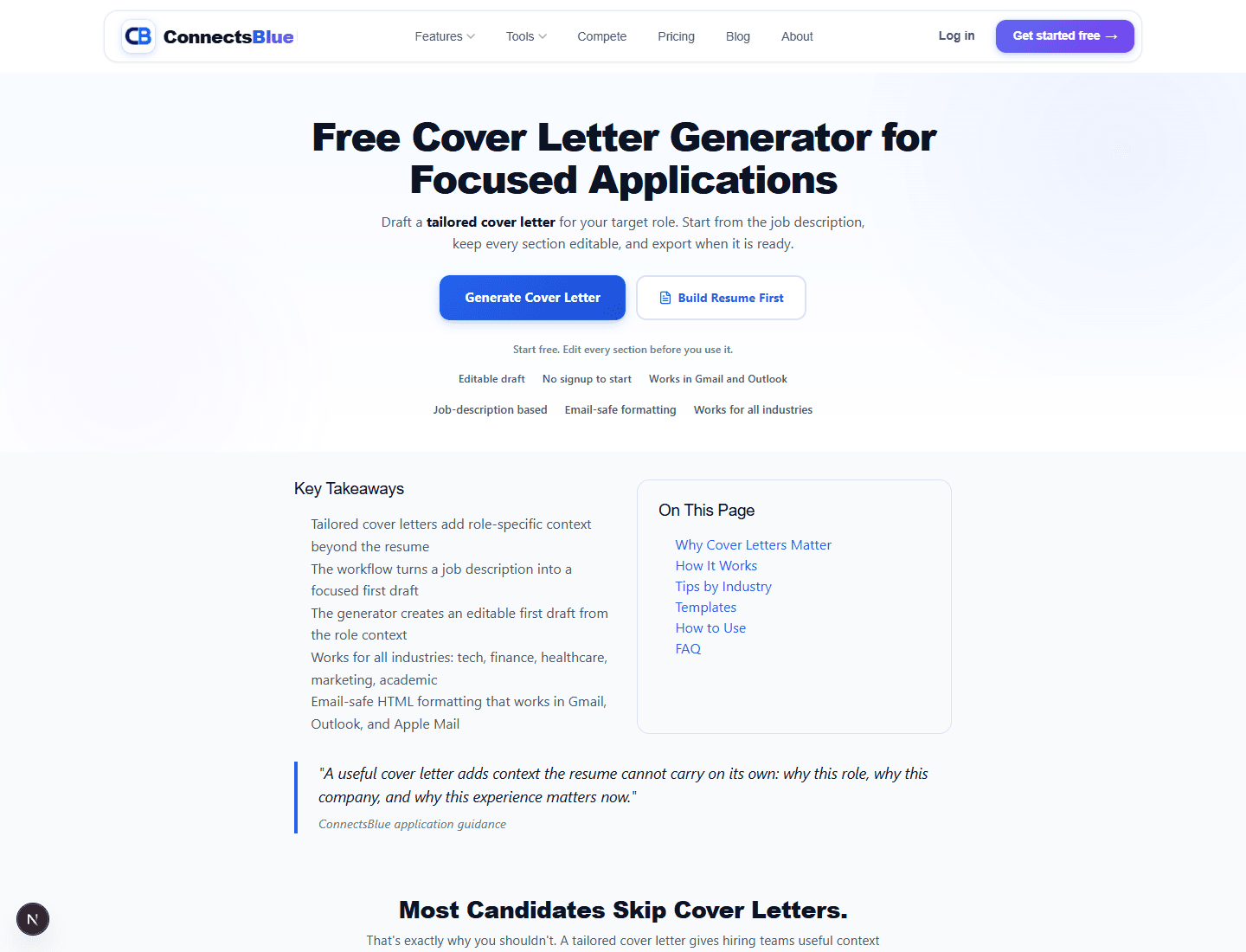
A cover letter is useful when it helps the recruiter understand fit that is not obvious from the resume alone. It should not repeat every bullet, make exaggerated claims, or sound like the same letter sent to every company.
The best cover letters are short, specific, and evidence-led. They connect one role requirement to one or two real examples, then explain why the candidate is interested in this team or problem.
A cover letter tool can speed up the first draft, but the final version still needs human judgment. The candidate should verify the facts, remove generic praise, and make sure every claim can be discussed in an interview.
Decision
Decide whether this application needs a cover letter
Not every application needs a long letter. The letter is most valuable when the role is competitive, the posting asks for motivation, the candidate is changing fields, or the resume needs context that a bullet cannot provide.
Before writing, decide what job the letter has to do. A student may need to translate project work into role evidence. A career changer may need to explain the bridge between industries. A senior candidate may need to show why this company, not just this title, is worth their attention.
Situation
Career change
Use the letter to explain
The transferable work, tools, and judgment that connect old experience to the new role.
Keep it short by avoiding
A long biography of the previous career.
Situation
Fresher or student
Use the letter to explain
Relevant projects, internships, coursework, and proof of follow-through.
Keep it short by avoiding
Apologizing for limited experience.
Situation
Senior role
Use the letter to explain
Scope, leadership style, and a specific reason for this company or team.
Keep it short by avoiding
Repeating every achievement from the resume.
Situation
Optional cover letter
Use the letter to explain
One clear reason the application deserves a closer look.
Keep it short by avoiding
Generic enthusiasm that could apply anywhere.
Evidence
Start from proof, not from a blank page
Weak cover letters usually begin with adjectives. Stronger ones begin with evidence: a project shipped, a process improved, a customer problem handled, a team supported, or a measurable result the candidate can explain.
Collect three pieces of evidence before drafting. Then choose the one or two that match the role most closely. The goal is not to include everything; the goal is to make the recruiter confident that the resume is worth opening carefully.
- Name the role requirement you are answering.
- Use one concrete example instead of three broad claims.
- Mention tools, methods, or domain context only when they mattered to the result.
- Use numbers when they are real and relevant, not as decoration.
- Remove any sentence that could be pasted into a different company application unchanged.
Role alignment
Use job description language without keyword stuffing
A cover letter can mirror important terms from the posting, but it should do so naturally. If the role asks for stakeholder communication, the letter should describe a real situation where the candidate worked with stakeholders. If the role asks for data analysis, the letter should name the analysis work and the decision it supported.
This is where many generated drafts need editing. They often include the right vocabulary but not enough proof. Replace vague alignment with one grounded example.
Job posting signal
Cross-functional collaboration
Weak letter sentence
I am a strong collaborator.
Stronger letter sentence
In my internship project, I coordinated design, engineering, and support feedback before releasing the dashboard.
Job posting signal
Customer empathy
Weak letter sentence
I care about users.
Stronger letter sentence
I reviewed support tickets weekly and used recurring issues to prioritize two onboarding fixes.
Job posting signal
Process improvement
Weak letter sentence
I improve workflows.
Stronger letter sentence
I reduced manual reporting steps by moving weekly updates into a shared tracker with clear owners.
Job posting signal
Technical ownership
Weak letter sentence
I have technical skills.
Stronger letter sentence
I built the API integration, tested error states, and documented the handoff for the next maintainer.
Structure
Use a four-part structure that stays readable
Most cover letters do not need more than three or four short paragraphs. A clean structure keeps the draft useful for recruiters and easier for the candidate to edit.
Opening
State the role and the reason this application is a fit. Avoid a dramatic hook; clarity is better than performance.
Evidence
Use one or two examples that map directly to the job description. Keep the examples specific and verifiable.
Company connection
Mention a real product, team, market, mission, or problem only if it connects to your experience or motivation.
Close
End with a simple statement of interest and availability. Do not oversell or pressure the reader.
Candidate stage
Adapt the letter to the candidate stage
A useful letter changes based on the applicant. A fresher, a career changer, and a senior operator should not use the same examples or tone.
Candidate stage
Fresher
Best evidence to use
Projects, internships, coursework, campus leadership, volunteer work, and tools used in real tasks.
Common mistake
Trying to sound senior instead of showing learning speed and ownership.
Candidate stage
Career changer
Best evidence to use
Transferable decisions, domain knowledge, customer exposure, process work, and recent proof of learning.
Common mistake
Explaining the entire transition instead of proving the next-role fit.
Candidate stage
Mid-career professional
Best evidence to use
Specific outcomes, systems improved, stakeholders handled, and scope of ownership.
Common mistake
Listing responsibilities without showing judgment or result.
Candidate stage
Senior candidate
Best evidence to use
Business context, team leadership, trade-offs, operating rhythm, and strategic impact.
Common mistake
Turning the letter into an executive summary that repeats the resume.
Drafting tools
Use a cover letter generator as a drafting aid, then edit hard
A generator is useful for turning a resume and job description into a first draft. It can save setup time, suggest structure, and surface role vocabulary that the candidate may have missed.
The generated draft should never be sent untouched. Read it line by line and ask whether each sentence is accurate, specific, necessary, and in the candidate voice. If the draft sounds polished but vague, simplify it.
- Check that every metric, tool, and project is true.
- Replace broad praise for the company with one specific reason for interest.
- Remove repeated phrases such as passionate, excited, ideal fit, and strong communicator unless the sentence proves them.
- Keep the final letter around one page and easy to scan.
- Read it aloud before sending; awkward sentences usually reveal template language.
Final review
Review the letter like a recruiter would
The final review should be practical. A recruiter is looking for role fit, credible evidence, and a reason to continue with the candidate. They are not looking for perfect prose or a dramatic personal story.
Use the checklist below before attaching or pasting the letter into an application form.
- The role title and company are correct.
- The first paragraph explains the application angle quickly.
- The strongest example is relevant to the job description.
- The letter adds context that the resume does not already explain.
- The tone is professional, direct, and not overly promotional.
- The final draft has no placeholders, invented facts, or unsupported claims.
Implementation notes
How to use this guide in a real hiring workflow
Use this article as a working review document, not just a buying overview. Compare cover letter guide: write a letter recruiters can use with the way your team currently works, then fix the places where ownership, evidence, or candidate communication is unclear.
- Name the owner for the stage before changing configuration.
- Define the evidence recruiters and managers should capture.
- Review candidate-facing messages for clarity and tone.
- Measure whether the change reduced delay, rework, or ambiguity.
Candidate questions
Cover Letter Guide: Write a Letter Recruiters Can Use FAQ
Should I always include a cover letter?
Include one when it adds context that the resume cannot show clearly, when the application asks for one, or when you need to explain a transition, motivation, or specific fit. Skip generic letters that repeat the resume.
How long should a cover letter be?
Most cover letters should be about three or four short paragraphs and fit on one page. The reader should understand the role, evidence, company connection, and next step without scrolling through a long essay.
Can I use a cover letter generator?
Yes, as a drafting aid. Use it to create structure and pull role vocabulary from the job description, then edit the draft for accuracy, specificity, and your own voice before sending.
What should a fresher write in a cover letter?
A fresher should use projects, internships, coursework, volunteer work, and campus responsibilities as evidence. The letter should show learning speed, ownership, and role relevance without pretending to have senior experience.
Next step
Draft a cover letter you can edit with confidence.
Use the ConnectsBlue cover letter tool to create a role-specific first draft, then review the evidence, tone, and company connection before sending.
Open Cover Letter Tool