DEI Hiring Analytics

You Can't Improve
What You Don't Measure.

DEI hiring analytics reveals where diverse candidates enter, advance, and drop off in your funnel — so you can fix systemic gaps with data, not guesswork.

KP
Karthick P.KMarch 2, 202611 min readRecruiting

"We're committed to diversity." — "Great. What's the pass-through rate for underrepresented candidates at your screening stage?" — "We... don't track that."

87% of companies say DEI is a priority. Only 19% measure diversity at every hiring stage. Without stage-by-stage DEI analytics, your diversity efforts are based on hope, not data. You might have a diverse top-of-funnel but lose representation at screening, interviewing, or offer stages — and never know it.

DEI hiring analytics provides visibility into your diversity recruitment metrics at every pipeline stage. It shows you exactly where underrepresented candidates drop off, which interviewers have scoring disparities, and whether your job descriptions attract diverse applicant pools. Data-driven inclusive hiring replaces performative statements with measurable progress.

This guide covers the 6 essential DEI hiring metrics, how to identify bias patterns in your funnel, the framework for building an inclusive recruiting process, and how ConnectsBlue's DEI analytics dashboard makes it measurable and actionable.

Why DEI Hiring Analytics Matter in 2026

The business case for inclusive hiring is indisputable.

35%
higher revenue in top-quartile diverse companies
87%
of companies prioritize DEI — only 19% measure it
2.3x
more innovative output from diverse teams
70%
of job seekers evaluate employer diversity

Building an Inclusive Hiring Framework

Most companies approach DEI hiring backwards — they set representation targets and work backwards. The data-driven approach is different: measure first, identify barriers, remove them, then watch representation improve organically.

Step 1: Audit your sourcing channels. Which job boards, referral programs, and outreach methods produce the most diverse applicant pools? If 80% of hires come from employee referrals and your team is homogeneous, your referral program is a diversity bottleneck — not a feature. Diversify your sourcing mix with targeted outreach to underrepresented communities, partnerships with diversity-focused organizations, and inclusive job board postings.

Step 2: Analyze your job descriptions. Research shows that gendered language, unnecessary requirements ("10+ years experience" when 5 would suffice), and jargon-heavy descriptions disproportionately discourage underrepresented candidates from applying. AI-powered language analysis can flag exclusionary patterns before you post.

Step 3: Standardize evaluations. Structured interview scorecards with predefined criteria reduce subjective bias by 42%. When every interviewer rates every candidate against the same rubric, scoring disparities become visible and correctable.

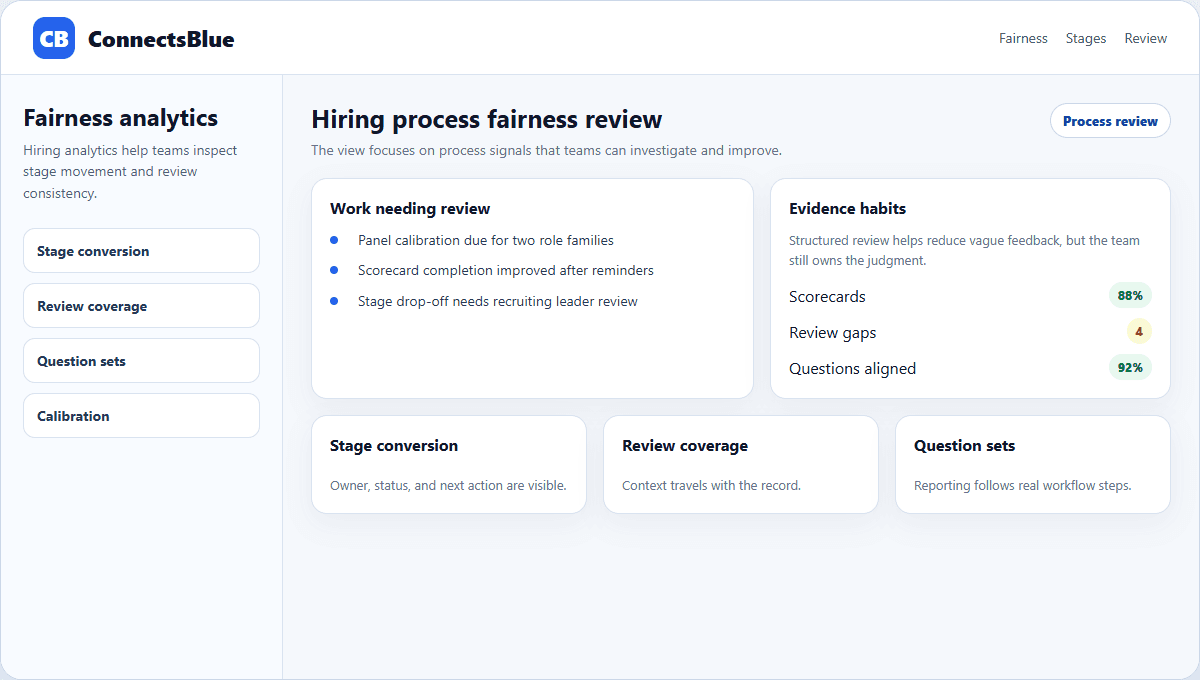
Step 4: Track, report, and iterate. Real-time DEI dashboards let you course-correct during active hiring — not six months later in an annual report. ConnectsBlue provides this visibility automatically, connecting your sourcing, screening, interviewing, and offer data into a unified diversity lens.

6 Essential DEI Hiring Metrics to Track

Applicant Pool Diversity

What percentage of applicants come from underrepresented groups? This measures whether your sourcing channels and job descriptions attract diverse talent. Low diversity here means fixing begins at the top.

Stage-by-Stage Pass-Through Rate

Track what percentage of diverse candidates advance at each stage vs. overall candidates. If diverse candidates apply at 40% but only 15% reach interviews, your screening stage has a bias leak.

Interview Score Parity

Do diverse candidates receive statistically similar scores to non-diverse candidates for the same role? Scoring disparities across interviewers reveal unconscious bias patterns that need calibration.

Offer Rate by Demographic

Are offers extended equitably across groups? If diverse candidates reach final rounds at 30% but receive offers at only 10%, there's a gap between interview performance and decision-making.

Source Diversity Attribution

Which channels deliver the most diverse candidates? Employee referrals, job boards, career sites, and events produce different diversity profiles. Double down on high-diversity sources.

Hiring Manager Patterns

Track hiring outcomes by manager. Are some managers consistently building diverse teams while others aren't? This data enables targeted training and accountability conversations.

How ConnectsBlue DEI Analytics Works

1

Optional Self-Identification

  • Candidates can optionally provide demographic data during application
  • EEOC-compliant data collection with clear privacy disclosures
  • Data is aggregated and anonymized — never visible on individual candidate profiles
  • Recruiter-blind: hiring teams never see demographic data during evaluations
2

Funnel Diversity Visualization

  • Visual pipeline showing diversity representation at every stage
  • Heat maps highlight stages where diverse candidates drop off
  • Compare across roles, departments, and time periods
  • Drill down from overview to specific role or team metrics
3

Bias Pattern Detection

  • AI flags statistically significant scoring disparities across demographics
  • Identify specific interviewers or stages with potential bias patterns
  • Track whether structured scorecards reduce disparities over time
  • Generate compliance-ready reports for leadership and legal teams
4

Actionable Recommendations

  • Data-driven suggestions: "Expand sourcing to these 3 channels for better diversity"
  • Training alerts: "Interviewer X shows scoring disparity — recommend calibration"
  • Job description analysis: flag non-inclusive language
  • Benchmark against industry DEI standards

4 DEI Hiring Analytics Mistakes to Avoid

Mistake: Only measuring diversity at the point of hire

Fix: Measure at every stage. A diverse applicant pool means nothing if screening eliminates representation before interviews.

Mistake: Making demographic data visible to hiring teams

Fix: Demographic data should be aggregated and anonymized for analytics only. ConnectsBlue ensures recruiter-blind evaluations.

Mistake: Setting quotas instead of removing barriers

Fix: DEI analytics should identify process barriers (biased language, limited sources, scoring disparities) — not enforce quotas.

Mistake: Reporting annually instead of in real-time

Fix: Annual DEI reports are post-mortem autopsy. Real-time dashboards let you course-correct while you're still hiring.

Key Takeaways: DEI Hiring Analytics

  • DEI hiring analytics reveals where diverse candidates drop off in your pipeline — so you fix barriers with data, not assumptions.
  • Track 6 essential metrics: applicant pool diversity, stage pass-through rates, interview score parity, offer rates, source diversity, and hiring manager patterns.
  • Companies in the top quartile for diversity report 35% higher revenue than less diverse peers.
  • ConnectsBlue provides EEOC-compliant, recruiter-blind DEI analytics with real-time funnel visualization and bias detection — free.
  • 70% of job seekers evaluate employer diversity before applying — DEI data improves your employer brand.

DEI Hiring Analytics FAQ

What are DEI hiring analytics?

DEI hiring analytics track diversity, equity, and inclusion metrics across your entire recruitment funnel. They measure representation at each pipeline stage — application, screening, interview, offer, and hire — to identify where diverse candidates advance or drop off, enabling data-driven inclusive hiring improvements.

Is it legal to collect demographic data during hiring?

Yes, when done properly. EEOC-compliant self-identification is voluntary, anonymized, and never used in individual hiring decisions. ConnectsBlue collects this data separately from candidate profiles, ensuring recruiter-blind evaluations while enabling aggregate diversity reporting.

How does ConnectsBlue detect bias in hiring?

ConnectsBlue's AI analyzes scoring patterns across demographics, interviewers, and pipeline stages. It flags statistically significant disparities — for example, if candidates from a particular group consistently receive lower interview scores than their assessment scores predict. This surfaces patterns invisible to manual review.

Is DEI analytics available on the free plan?

Yes. ConnectsBlue's free plan includes basic diversity pipeline visualization and stage-by-stage reporting. Pro subscribers get AI-powered bias detection, interviewer scoring analysis, source diversity attribution, and exportable compliance reports.

Make Diversity Measurable

Stop guessing about your diversity efforts. Get real-time DEI hiring analytics that drive real inclusion.

No credit card. EEOC-compliant. Privacy-first design.

You Might Also Like

Continue exploring career insights and tips

Best AI Applicant Tracking System (ATS) in 2026 — Free
Recruiting

Best AI Applicant Tracking System (ATS) in 2026 — Free

The #1 AI-powered ATS that scores candidates, runs video interviews, and manages your pipeline — all in one platform. Free forever plan. Start in 2 minutes.

10 min read
Read More
Best AI Recruitment Software 2026: Screen 10x Faster
Recruiting

Best AI Recruitment Software 2026: Screen 10x Faster

Discover the #1 AI recruitment software that scores candidates before you see them. Cut time-to-hire by 60%. Free plan available — start in 2 minutes.

8 min read
Read More
AI Video Interview Platform: Screen 100 Candidates Overnight
Recruiting

AI Video Interview Platform: Screen 100 Candidates Overnight

Replace phone screens with AI video interviews. Candidates record. AI scores. You review the best. Free setup — no scheduling, no phone tag, no wasted hours.

9 min read
Read More